Table of Contents
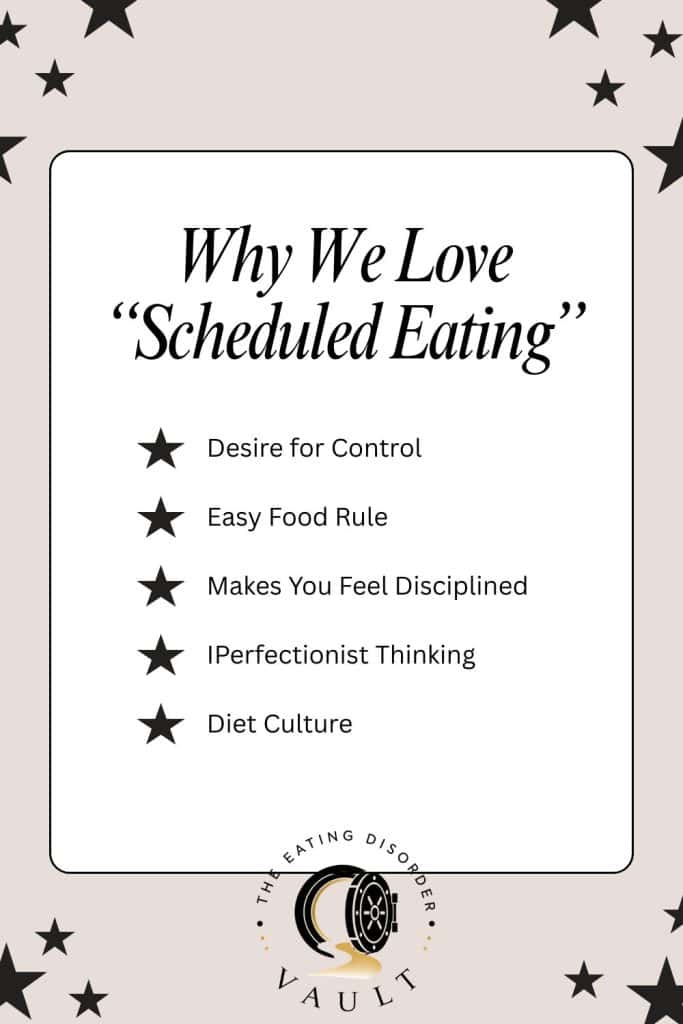
There is something oddly satisfying about eating on a schedule.
Breakfast at 8. Lunch at 12. Snack at 3. Dinner at 6.
It feels organized. Predictable. Disciplined. And in a world where nutrition advice constantly tells us to optimize everything, having a strict eating schedule can feel like you’re “doing it right.”
But here’s the problem…
The moment your schedule becomes more important than your body’s signals, you’ve stopped using structure as a tool and started using it as a rule. In this article, we’re going to explore where the rule of only eating at designated times comes from, why it can quietly disconnect you from your body’s needs, and what a more flexible, peaceful approach to eating actually looks like
The Reason People Become Obsessed With Eating on a Schedule
Humans love certainty.
We like knowing what’s expected of us because it removes the mental effort of constantly making decisions. The same reason we create morning routines, set alarms, or eat tacos every Tuesday is the same reason rigid eating schedules can become so appealing.
There are two primary reasons someone may be “saving themselves” for their designated meal slot.
- They’re attempting to regiment their body to a structured system (aka- control it)
- They’re participating in the intermittent fasting fad diet
Now let’s be clear. We’re not talking about when we get the tummy rumblies because our designated lunch at work has been 12:00p.m. for the past 12 years.
Your body may prepare for a meal time it is familiar with and that can certainly be congruent with intuitive eating practices.
What we’re talking about here is:
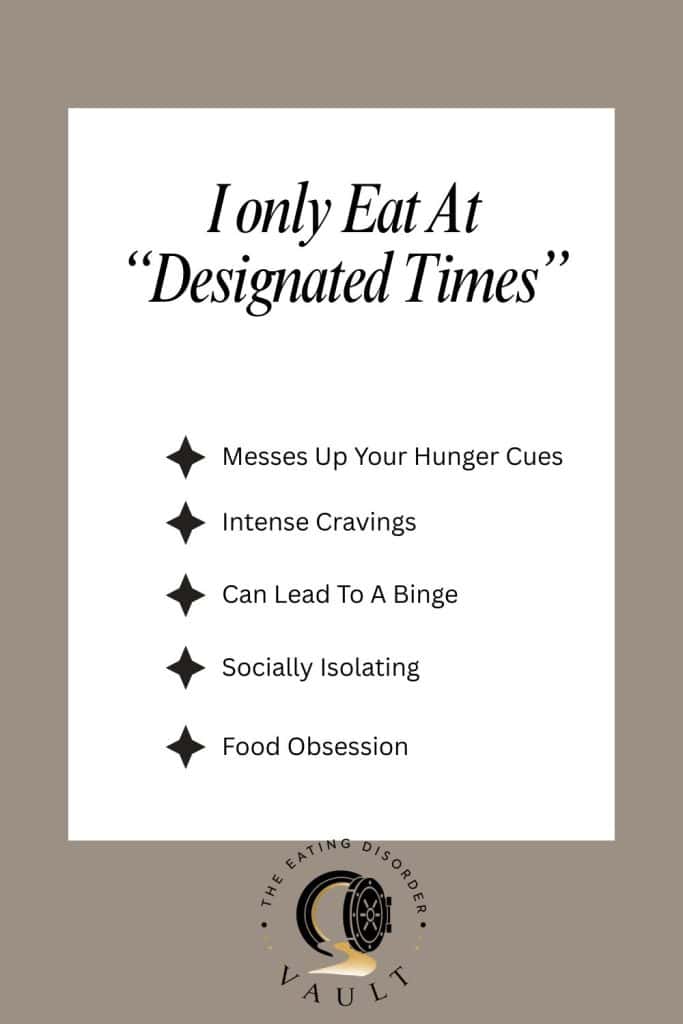
- When you’re eagerly looking at the clock holding your breath until your next “snack is due.”
- You are proud of the fact you ONLY eat between the hours of 12 p.m. and 6 p.m.
- You WON’T eat dinner before 6, even if you’re feeling super hungry at 4:55.
- If you simply CAN’T have the doughnuts in the office because they aren’t scheduled for snack time nor the on the self proclaimed meal plan.
A rigid eating schedule creates the illusion that you’re in control of your body. If you can ignore hunger until noon every day, delay dinner no matter how hungry you are, or proudly announce that you “never eat after 7 p.m.,” it can feel like an accomplishment. When eating becomes something that is dictated by a clock instead of a conversation with your body, there is no longer any uncertainty. You don’t have to ask yourself whether you’re hungry. You don’t have to decide if now is a good time to eat. You simply look at the clock and follow the rule.
This rigid meal and snack schedule creates clarity…. but at what cost?
It’s Okay to Eat Before Your Scheduled Meal
We praise discipline. We admire self-control. We celebrate people who can ignore cravings, push through hunger, or follow strict routines without deviation. The more difficult the rule, the more virtuous it can seem.
But your body doesn’t hand out trophies for ignoring its needs.
Hunger isn’t a character flaw. It isn’t a lack of willpower. It’s simply your body’s way of asking for energy.
Many people believe that if they allowed themselves to eat whenever they felt hungry, they would never stop eating. They imagine themselves grazing all day long or losing complete control around food.
Ironically, the opposite is often true.
Hunger Doesn’t Care What Time It Is
It doesn’t know it’s 11:47 a.m. It doesn’t care that dinner is “only an hour away.” It certainly didn’t get the memo that you’re trying intermittent fasting this week.
Your body is paying attention to something much more important than the clock.It’s paying attention to whether it has enough energy to keep you alive.Hunger is a biological signal, not a scheduling conflict.
Every day is different. Some days you sleep more. Some days you exercise. Some days you’re stressed. Some days you’re sick. Some days you accidentally skipped breakfast because your kid spilled cereal on the dog and chaos won.
When we have to go to the bathroom we don’t say “Damn it! It’s not 12:30 yet.”
You don’t sit on the john and say “I’m going to make a calculated decision about whether it will serve me best to poo or pee right now.”
At least I hope not. Because that would be insane! And so is creating a rigid agenda about when we can or cannot put life sustaining substances into our mouths.
It would make very little sense for your hunger to show up at exactly the same time and with exactly the same intensity every single day.Imagine if your gas gauge in your car only worked between 12:00 and 6:00 p.m.You could be running on fumes at 10 in the morning, but the dashboard would simply shrug and say, “Sorry. Come back later.”
Yet that’s essentially what many of us ask our bodies to do.
Why Food Doesn’t Need an Appointment
Food has somehow become something we schedule like a business meeting. We carve out approved eating windows, assign designated meal times, and convince ourselves that eating outside of those windows is evidence that we’ve failed. It’s almost as if our hunger is expected to RSVP before it’s allowed to show up.
One of the strangest things we’ve normalized in diet culture is the idea that we need permission to eat. Not permission from another person, but permission from the clock.
Think about that for a second.
How many times have you caught yourself looking at the time and thinking, “It’s only 10:45. I should wait another hour.” Or maybe you’ve been genuinely hungry at 4:30 in the afternoon but decided to white-knuckle it until dinner because eating beforehand somehow felt like breaking the rules.
The clock became the decision-maker, and your body was expected to sit quietly until its turn.When your body needs fuel, it sends a signal.
That’s hunger. It isn’t asking whether now is convenient. It isn’t checking to make sure you’ve hit your fasting goal for the day. It isn’t trying to sabotage your weight loss efforts or test your self-control. It’s communicating one very simple message:
“Hey… we’re running a little low over here.”
The problem is that many of us have become so accustomed to overriding that message that we’ve started believing the clock is more trustworthy than our own physiology.
A Better Way to Think About Meal Timing
The difference is flexibility.
A flexible eater recognizes they’re hungry and responds as soon as it’s reasonably possible.A rigid eater recognizes they’re hungry and decides their body has to wait because the schedule says so.
It has no idea that lunch is supposed to happen at noon or that dinner isn’t until six. It doesn’t know that your intermittent fasting app says you have another forty-three minutes before your eating window opens. It only knows whether it has enough energy to keep your brain functioning, your muscles moving, your heart beating, and every other incredible process that keeps you alive.
Those may look similar from the outside, but psychologically they’re worlds apart.
This doesn’t mean every moment of hunger requires you to immediately sprint toward the nearest snack. Life happens. Meetings run long. You’re in the middle of a road trip. Sometimes you have to wait a little while before eating, and that’s perfectly normal.
Let’s be clear here. I’m not saying that we cant have a usual time when our body feels its best to nibble on things.
The problem arises when we feel these are the ONLY times we have permission to eat.

- Meal Support For Eating Disorders - August 12, 2026
- Vegetarian & Vegan Eating Disorder Recovery - July 28, 2026
- I only shop the perimeter of the grocery store - July 26, 2026