Table of Contents
Last updated on July 28th, 2026 at 01:34 am
If you’ve spent any amount of time in the health and wellness world, you’ve probably heard someone tell you to “just eat clean.” It sounds like simple, common-sense nutrition advice. But have you ever stopped to ask what that actually means?
What qualifies as “clean” food? More importantly, if some foods are clean, does that automatically make other foods dirty?
This article explores some of the roots behind “clean eating” why these origins are problematic, and how these concepts can negatively impact our overall well-being.
What Does “Eating Clean” Actually Mean
That’s actually a much harder question to answer than most people realize.
Ask ten different people what “eating clean” means, and you’ll likely get ten different answers. For one person, it means avoiding sugar. For another, it’s cutting out processed foods. Someone else believes it means eating organic, gluten-free, dairy-free, seed oil-free, low carb, paleo, or only foods with ingredients they can pronounce.
The problem is that there has never been a universally accepted definition of clean eating. It’s not a medical diagnosis. It’s not a nutrition standard. It’s not a scientific term recognized by registered dietitians or major health organizations. It’s simply a phrase that has accumulated different meanings depending on which influencer, wellness trend, or diet philosophy someone follows.
So instead of exploring what it means, this article is going to dig into why the phrasing and mentality of clean eating is such a problem!
Where Did the Idea of “Clean Eating” Come From
My very first thought on this one extends all the way back to the good old days when I journeyed into reading the holy bible cover to cover. I also want to note I have zero religious affiliation so I apologize if i’m interpreting this slightly off. I wasn’t raised in this sector. However- if I’m interpreting it this way there’s a good chance many others are also getting this message. Even if it wasn’t how it was intended.
Biblically- everything extended into the concept of cleanliness. From being able to participate in the church, hold authority, leave our camps, or even shake hands with someone! To be unclean in many instances actually separated you from God. It created isolation and was directly related to worth. If you were deemed unclean- even if only for a segment of time your potential outcome was:
- Not being able to be touched.
- Exclusion from the camp.
- Exclusion from the church.
- Revoked priesthood.
- Unsuitable for marriage
- A disowned child
Essentially- all human connections start to deteriorate with increasing degrees of “uncleanliness.” This is so super powerful because as humans we MUST connect. To be the “other” means to lack love, social connection, and in some cases even the ability to stay alive.
Now I want to make it clear here that I’m NOT talking about keeping kosher and biblical clean and unclean foods. Ironically- while the language is similar keeping kosher does not come alongside with heavy associations of guilt, shame, and other-hood biblically.
How Cleanliness Became Associated With Worth
Let’s shift a few millennia. What implications does a lack of cleanliness imply about our value as a person? Heres a few thoughts on what I commonly hear associated with lack of cleanliness:
- Poverty
- Diseased
- Undisciplined
- Unmotivated
- Unlovable
- Low social status
- Fat
Now for the question no one ever asks: If you’re eating clean- what’s eating “dirty?” What exactly does dirty say about you? By eating clean foods, we have an unconscious presumption we are “stepping up” in the ladder of life. In reality- this has nothing to do with “clean” and “dirty” foods. It has to do with creating otherness. Alienation. A moral standard of eating that distinguishes us from our undisciplined, unmotivated, and ravenous peers.
What is a synonym we often use in American culture for someone unmotivated, undisciplined, and unable to stop eating: Fat. So to translate all of this: we ought to eat clean so that we will not be fat. And the beauty of “eating clean” for diet culture’s advantage is this: it actually has no definition. Which mean’s every single person on the planet is certain to fall short of of the “eating clean” standard of greatness at all times.
And that’s diet culture because, as a society, we have to continue to invest in maintaining this set apart standard of cleanliness. So while we’re speaking language like “eat clean” we’re actually saying a whole lot more than this seemingly innocent statement.
If Food Can Be “Clean,” Does That Make Other Foods “Dirty”
This is the question almost no one asks.
The phrase eat clean sounds harmless on the surface. It feels positive. Aspirational, even. But language doesn’t exist in a vacuum. Words create meaning through contrast.
If something is clean, something else must be dirty.
We don’t need someone to explicitly say it. Our brains naturally fill in the blanks. That’s how language works. We understand “hot” because there’s “cold.” We understand “light” because there’s “dark.” And we understand “clean” because there’s “dirty.”
So what happens when we apply those labels to food?
Suddenly, food is no longer just food. It becomes a reflection of character.
A salad becomes a “good” choice. A slice of cake becomes a “bad” one.
An apple is “clean.” A bag of chips is “dirty.”
Without realizing it, we’ve shifted from talking about nutrition to talking about morality.
Why the “Eat Clean” Rule Does More Harm Than Good
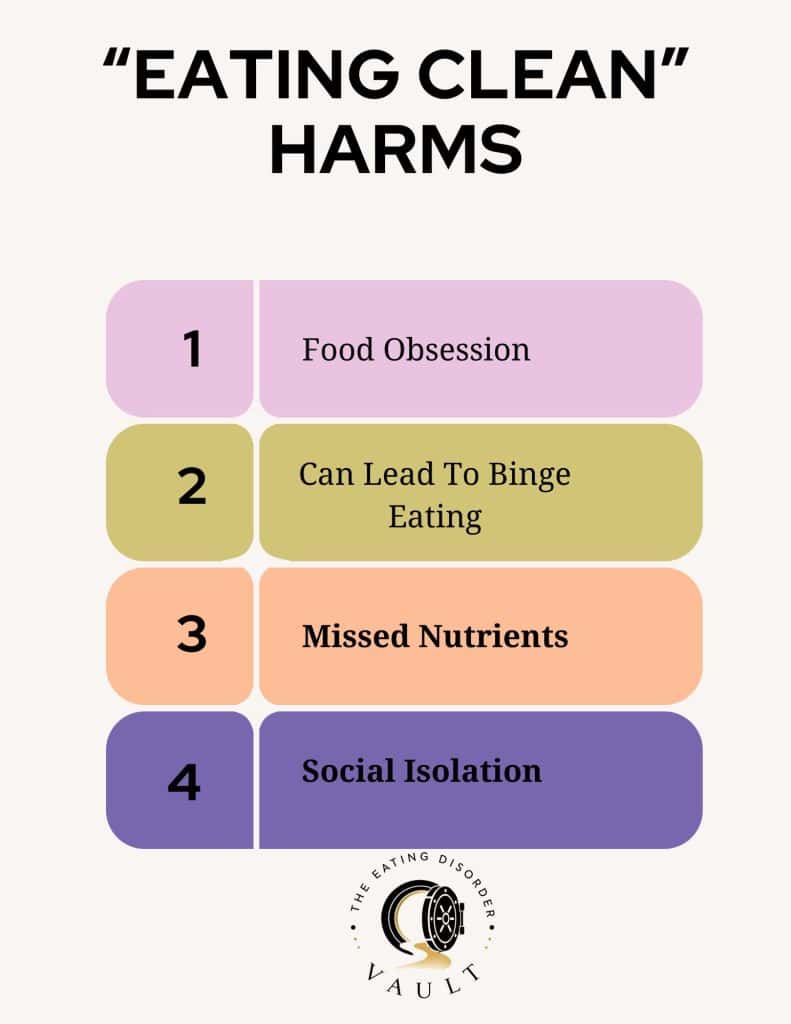
This rule sucks because it alienates well…everyone. You will always feel isolated when we can’t meet the impossible standard. Even if you attempt to follow clean eating “codes of conduct” you can’t. Because- there actually aren’t any. But there is NO shortage of scrutiny for mishaps in meeting the hypothetical codes of conduct YOU have created in your own mind regarding what is clean and what is not clean to eat.
Trying to “eat clean” will only lead to:
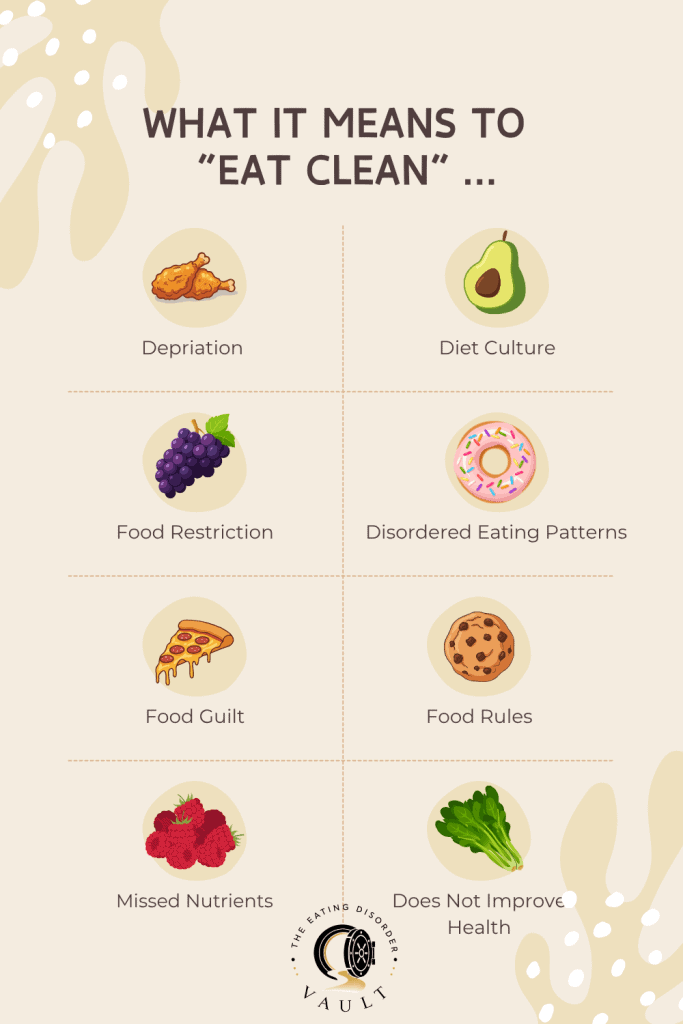
- Disordered thoughts about food.
- Food restrictions.
- Potential lack of nutrients in off limits foods.
Admittedly, this food rule REALLY sparked a surge of frustration in my brain when my daughters’ (age 16) athletic academic instructor (to protect privacy I won’t say which one as my goal is not to inflict scrutiny, but just build awareness) recommended ONLY “eating clean” foods for a very highly intense aerobic sport. It’s the water we swim in. And if we’re not cautious- it will consume us!
You Don’t Need to Eat “Clean” to Be Healthy
Your body doesn’t require “clean” foods. It requires nutrients. Those nutrients can come from a wide variety of foods—fresh, frozen, canned, packaged, homemade, restaurant meals, convenience foods, and everything in between.
Health isn’t determined by whether every ingredient on a label is recognizable or whether every meal was made from scratch. It’s built through consistent patterns over time.
Eating vegetables with dinner is healthy.
So is grabbing a frozen meal when you’re exhausted and it’s the difference between eating and skipping a meal.
Health isn’t built by perfectly following an undefined set of food rules. It’s built by consistently meeting your body’s needs, allowing flexibility, and recognizing that your worth has never depended on what was on your plate.

- Meal Support For Eating Disorders - August 12, 2026
- Vegetarian & Vegan Eating Disorder Recovery - July 28, 2026
- I only shop the perimeter of the grocery store - July 26, 2026