Last updated on November 8th, 2026 at 11:09 pm
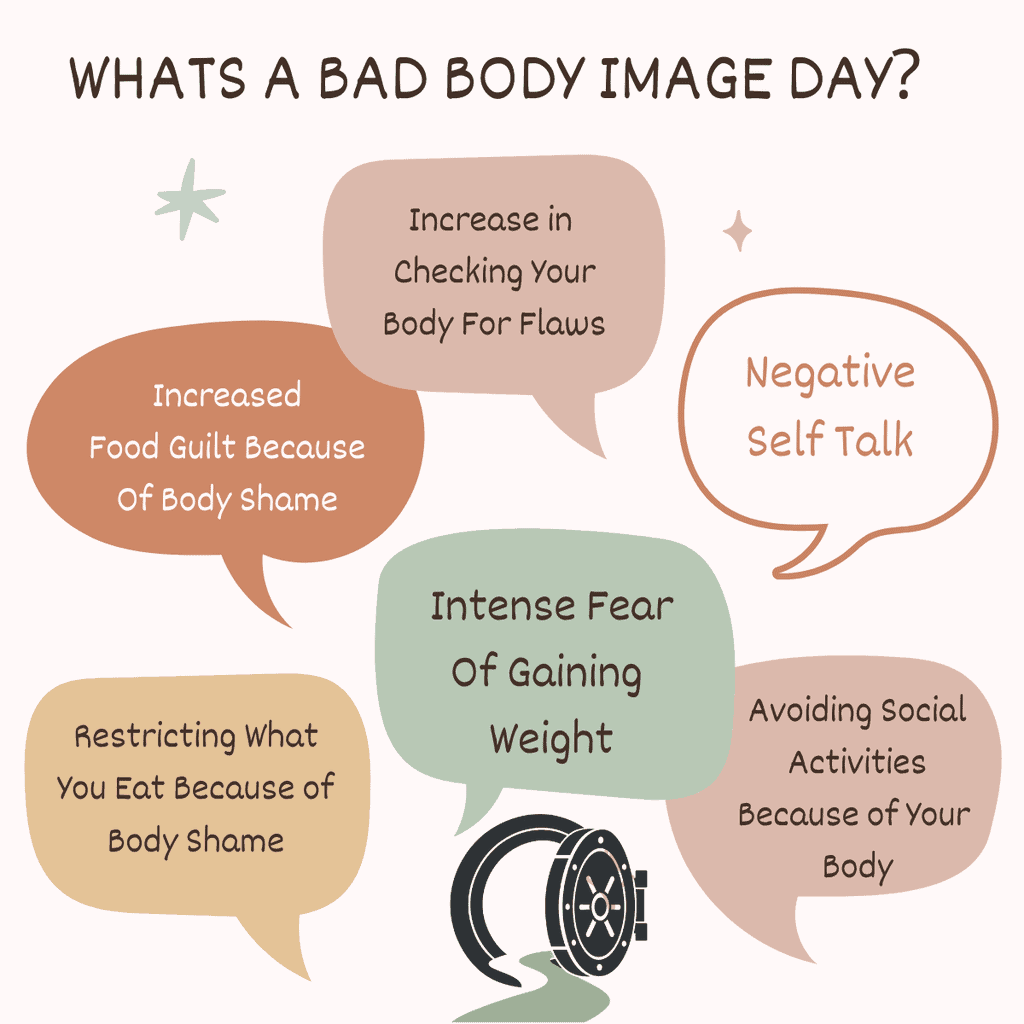
We all have days when looking in the mirror feels harder than usual. Bad body image days can show up out of nowhere, maybe a passing comment, a picture on social media, or just waking up feeling “off” in your skin.
These moments can feel heavy, but they don’t define your worth or the progress you’ve made in your journey toward self-acceptance. The good news? There are practical, compassionate ways to support yourself when negative body thoughts creep in.
In this post, we’ll explore 10 ways to cope with bad body image days so you can gently shift your focus away from criticism and toward care, kindness, and connection.
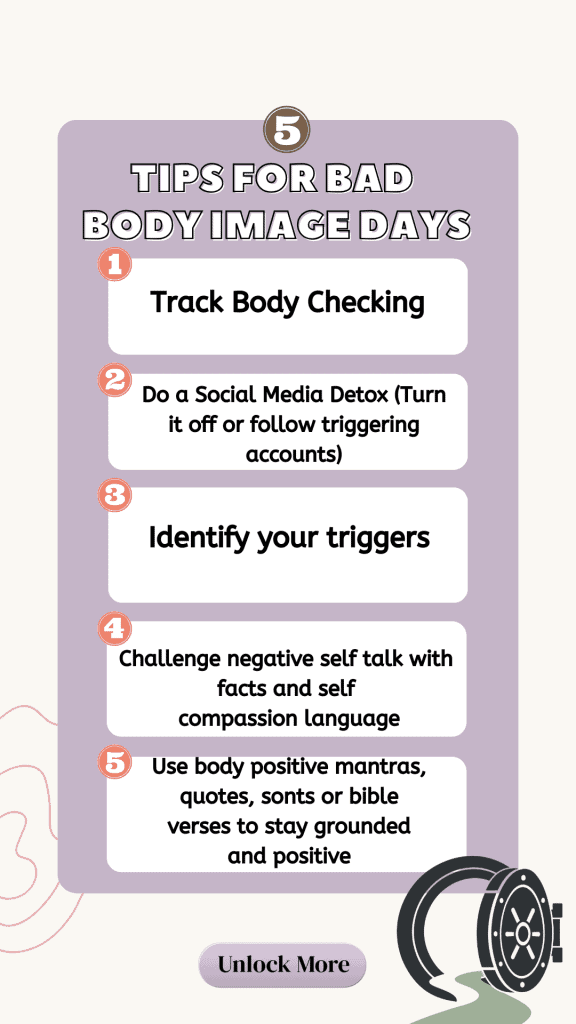
Tips To Cope With A Bad Body Image Day
Pause and Acknowledge Your Feelings
Your goal isn’t to “fix” your thoughts instantly, it’s to pause, notice, and understand them with self-compassion. Over time, this builds resilience and helps you respond to negative body thoughts more calmly.
Here’s a few tools to help you do this:
- Notice the Feeling Without Judgment: Take a slow breath and acknowledge: “I am feeling negative about my body right now.” Remind yourself: thoughts and feelings are temporary, they don’t define your worth.
Avoid labeling yourself as “bad” or “weak.” Simply notice them. - Pause Before Reacting: Give yourself a moment to step back instead of immediately trying to “fix” your thoughts. Try grounding techniques: feel your feet on the floor, press your hands together, or focus on your breath for 10–15 seconds.
- Identify the Trigger: Ask yourself: What triggered this body image thought? Some examples of triggers include social media, a comment, or mirror comparison. Naming the trigger shows that the thought comes from outside influences. not reality.
- Label the Thought: Recognize that your thought is just a thought, not a fact. Example labels: This is a negative body image thought.” , “This is my eating disorder voice talking.”This is a critical inner dialogue, not reality.”
- Investigate the Thought: Ask gentle questions such as:Is this thought 100% true? Would I say this to a friend or my child? What evidence supports or disproves it? This isn’t arguing with yourself, but seeing the thought clearly.
- Shift to Compassionate Curiosity: Treat your mind like a curious scientist, not a harsh judge. Observe patterns: “I notice I feel this way when I compare myself to others online.” Compassionate observation reduces shame and self-criticism.
- Reframe the Thought: Turn criticism into a neutral or positive statement. For example: “I hate my thighs” → “My thighs are strong and allow me to move every day.” or “I’m so fat” → “My body is healthy and capable of supporting me.”Reframing isn’t about forcing positivity, it’s about seeing reality more accurately.

Shift Focus Away From Your Appearance
Try practicing activities that shift your focus away from your appearance. On a bad body image day immerse yourself in something unrelated to appearance. This can include a hobby such as playing an instrument, dancing, art, or connecting with a friend.
Engaging your mind elsewhere naturally reduces obsessive body thoughts. Creating habits with activities you enjoy can increase the enjoyment and make you choose these on a difficult day. Focus on achievable tasks: eating a balanced meal, going for a walk, or finishing a work task.
Celebrating completing the task reinforces accomplishment over appearance. Reward yourself for non-scale victories such as work accomplishments, improvements in a skill or awards you’ve received recently. Put these on display to remind you of your success.
Wear Clothes That Feel Comfortable
If you feel like you hate your body a lot of it can come down to not feeling comfortable in what you’re wearing. Wearing clothes that feel comfortable can be surprisingly powerful on bad body image days because it supports both physical ease and mental well-being. A waistband digging into your stomach can keep pulling your attention back to your body. Change into something that gives you room to sit, breathe, and eat, rather than repeatedly checking whether the uncomfortable outfit feels different yet.
Choose one or two dependable outfits for these days, and move clothes that no longer fit out of your everyday rotation if you can. You do not need to turn getting dressed into a test of whether your body is acceptable. Tight or restrictive clothing can heighten bodily tension and intensify negative thoughts. “Feeling fat” can often boil down to just being in the wrong sized clothing. Soft, loose, or favorite pieces allow your body to move freely and your mind to relax.
Choosing comfort over appearance naturally shifts your focus away from scrutinizing your body, reducing obsessive comparison and self-criticism. It also acts as an act of self-kindness, signaling to yourself that your needs and comfort matter, which can boost confidence and a sense of control.
Additionally, comfortable clothing encourages mindfulness, helping you stay present in your activities rather than getting stuck in negative body loops. Overall, wearing clothes that feel good is a simple yet effective way to foster self-compassion and calm your mind on challenging body image days.
Nourish Yourself With Food and Rest
Nourishing yourself properly and practicing intuitive eating can have a profound impact on bad body image days because they shift the focus from restriction and control to care, trust, and body awareness.
When you eat in a way that truly fuels your body, honoring hunger and fullness cues, including a variety of foods, and allowing yourself flexibility, you send a message to yourself that your needs matter, not just your appearance. This helps reduce the mental tension and guilt that often accompany negative body thoughts. Intuitive eating also strengthens your connection to your body’s signals, fostering trust and confidence in your body’s wisdom.
Practice Taking “Bad” Photos
You are allowed to exist in pictures without finding your best angle first. Laughing with your chin tucked, sitting with your stomach relaxed, or getting caught mid-bite does not make a photo a mistake that needs deleting.
Research on the mere exposure effect suggests that repeated exposure can increase how much we like something. A 2017 analysis of studies on exposure and liking found that this effect has limits: more exposure does not keep increasing liking forever, and the findings do not prove that repeatedly looking at a disliked photo will make you love it. But “loving” every photo isn’t the point.
For body image, a useful goal is becoming more comfortable seeing yourself in ordinary pictures without immediately trying to correct, hide, or erase your appearance. The Centre for Clinical Interventions identifies avoiding photos and only keeping heavily edited or carefully controlled images as behaviors that can maintain appearance concerns.
Here are some ways to practice:
- Start with a manageable photo. Choose one you feel somewhat uncomfortable with rather than the picture that sends you straight into a spiral. You can keep it private.
- Let someone take a picture without directing every detail. Practice leaving your stomach relaxed or staying in your seat instead of rearranging yourself into your approved photo position.
- Keep one imperfect picture. Resist immediately deleting it, cropping yourself out, or taking 30 replacements. You do not have to post it.
- Look at the whole scene. Notice who was there, what you were doing, and the setting instead of zooming in on one body part. Try a factual description: “I’m sitting beside my friend at dinner.”
- Return to ordinary photos on different occasions. Practice allowing them to be part of your memories without turning each viewing into an inspection. You do not need to stare until you feel attractive.
- Measure progress by what you allow yourself to do. Keeping a picture, joining a group photo, or returning to your day without restricting food afterward can count even when you still dislike the image.
- Make it Your Job. One thing I always tell myself when I KNOW I don’t feel attractive enough for a photo is to consider others that might benefit from the experience from a photo with me. When my daughter asks me to take a photo I would normally shy away from because I “feel fat” or “don’t like my hair that day” I shut all of that down for a moment and remind myself it’s my responsibility as her parent to be present, not perfect.
Your camera roll is allowed to contain evidence that you lived a life, including moments when you were more interested in the birthday cake than your jawline.
Move Your Body in Gentle Ways
You do not owe your body a walk because you dislike how it looks. Rest is a valid choice, and you do not have to prove that you are taking care of yourself through exercise.
If movement is medically appropriate and feels freely chosen, you might enjoy dancing to a song or a short stretch. Movement you enjoy should not become another requirement for earning food or calming a fear of weight gain. Activities like walking, stretching, yoga, dancing, or light resistance exercises allow you to connect with your body’s strength, flexibility, and sensations rather than judging how it looks. Gentle movement also helps reduce stress and anxiety by releasing endorphins, improving mood, and calming the nervous system. It fosters mindfulness, encouraging you to notice and appreciate what your body can do, which builds trust and respect for your body.
If it feels compulsory, is meant to undo eating, or goes against recovery guidance, leave it out and choose a different activity. NICE recommends stopping excessive exercise in eating-disorder treatment; calling it “gentle” does not automatically make it appropriate.
Limit Social Media and Comparison
Limiting social media can be a powerful tool for managing bad body image days because it reduces exposure to constant comparisons and unrealistic beauty standards. Social media often highlights edited, filtered, or carefully curated images that can make you feel inadequate or trigger negative self-talk. Content promoting thinness and food restriction is everywhere.
By taking a step back, whether that means logging off, unfollowing triggering accounts, or setting specific time limits, you give your mind space to focus on reality rather than comparison. This break allows you to reconnect with your own body’s needs, appreciate your accomplishments, and practice self-compassion without external pressure.
Practice Gratitude For What Your Body Can Do
Ask: “What can my body do today?” For example: walking, stretching, dancing, lifting, breathing deeply, or carrying groceries. Celebrate these abilities instead of evaluating looks.
I always encourage people to dig really deep into this by isolating a body part and serving it up with some compliments and thanking it for something specific. For example, if you’re on a jog you might say “thank you so much for helping me use oxygen today lungs. I was able to run across the park and you helped me use the oxygen I needed. You’re so strong.”
In fact… get weird about it. If you’re not feeling like an idiot at first, you’re not doing it right. treat each body part like an independent partner working with you to move you through the world.
I often recommend starting by complementing something that feels uncomfortable as this is often an immediate focus for us. For example, if your feet hurt because you walked too long or even have a mild injury, think about how you can speak kindly to that body part rather than becoming frustrated. For example, if your ankle hurts you might say “you’re such a strong little ankle. I know you’re hurting but that you’re working hard to heal me right now. I know you’re using your muscles and even using your unique healing powers to make sure that I am safe. Thank you.”
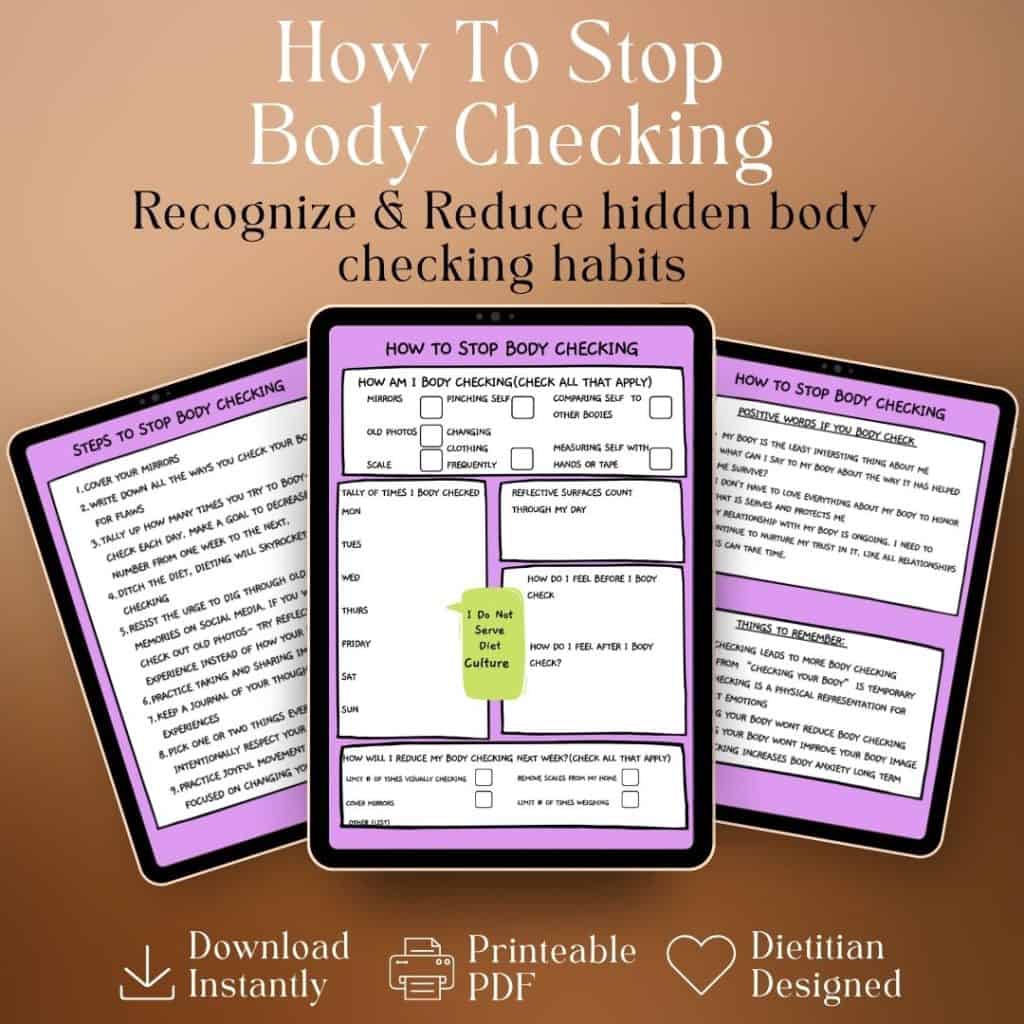
Track Your Body Checking
Tracking body checking can be a very effective strategy for managing bad body image days because it helps you bring awareness to automatic behaviors and reduce their power over your thoughts and emotions.
Body checking, such as repeatedly looking in the mirror, pinching, measuring, or weighing yourself, often happens unconsciously and can reinforce negative self-talk. By keeping a log of when, where, and why you engage in these behaviors, you start to notice patterns and triggers, which is the first step toward changing them.
Tracking also allows you to reflect on how these behaviors affect your mood and body perception, helping you see that checking rarely brings reassurance and often worsens negative thoughts.

Pull Out Your Positive Quotes & Journal prompts
Journaling, body image quotes, and body positive bible verses can be powerful anecdotes for negative self talk.
Here are a few things to do on a regular basis to reduce or eliminate bad body image days altogether.
- Daily journaling: Journal using body positive prompts or about the emotions that come up about your body
- Mirror work: Say 1–2 body positive statements aloud while looking at yourself.
- On-the-go reminder: Keep a screenshot on your phone for quick use during tough moments.
- Anchor thought: Use a favorite statement as a “mental anchor” when the inner critic is loud.

- Dating Someone With an Eating Disorder: Supporting Them Without Losing Yourself - October 19, 2026
- The Evolution of Thinspo: From Pro-Ana Websites to SkinnyTok - September 19, 2026
- Meal Support For Eating Disorders - August 12, 2026