Table of Contents
Last updated on March 12th, 2026 at 09:59 pm
Do you feel fat all the time? Do you find yourself constantly on a diet, looking in the mirror “one more time” or feeling uncomfortable in any outfit you put on? Are you spending 80% of your day thinking about your body or how to change it?
What if I told you that feeling fat constantly actually has nothing to do with your body? Or that losing weight wont actually help you to stop feeling fat? What if I told you that feeling fat actually has very little to do with being fat?
Feeling fat constantly often comes from:
- Negative self talk
- Diet culture
- Anxiety
- Disordered eating or eating disorders
- Weight comments (either towards you or by you towards others)
This article explores some of the roots as to why you are probably feeling fat most of the time and tools that you can use to improve your body image.

10 Reasons I Feel Fat All The Time
If you constantly feel like “the elephant in the room” everyone is talking about, this actually has nothing to do with you or your body. Feeling fat is a very common experience for almost everyone in western culture. This is because there is constant pressure to lose weight regardless of your body size as living in a society that doesn’t accommodate the variety of body sizes that naturally occur in the world.
You might feel fat all of the time because:
- You can’t find clothes that fit (this is actually a manufacturing problem, not a body problem)
- You can’t fit onto an airplane seat (this is the result of poor airline design, not your body)
- You can’t find proper sporting equipment (this is again. manufacturing problem)
- Social media is bombarding you with pressures to lose weight and photos of successful thin bodied people
- The BMI scale we use to predict health is faulty, racist, sexist and fatphobic
- Medical providers and educators dismiss your medical problems and prescribe weight loss instead
- You are bullied or shamed for your body
- You are told that if you cant lose weight or remain thin you are lazy, undisciplined, and unworthy
- You’re food shamed for enjoying foods that are associated with weight gain
- You’re unfamiliar with your new body if you have gained weight
Regardless of your body size, feeling fat or living in a fat body is not the problem here. Discrimination is. Bullying is.
Losing Weight Won’t Help You Feel Less Fat
Feeling fat has more to do with feelings of inadequacy and low self esteem than the physical space your body takes up. While you might think that losing weight is the obvious solution to “feel less fat” it’s actually quite the opposite. While losing weight can provide some momentary relief from “feeling fat” these good feelings are usually short lived.
Because feeling fat is often the physical manifestation of difficult emotions, feelings of inadequacy are left lingering even if you do have less fat on your body. Dealing with negative emotions and improving overall body image is a much more effective way to “feel less fat” than losing weight.
Trying to lose weight can cause:
- An obsession with weighing yourself
- Feelings of inadequacy when you don’t lose weight “fast enough”
- Feeling failure if you don’t lose weight or can’t lose enough
- Constantly body checking (with mirrors, pinching your wrist, changing clothes)
- Constant fear of gaining weight if you do lose weight
If you are trying to lose weight to combat negative body image, it is much more likely to lead to feelings of inadequacy and as though it’s never quite enough than it is to positive self esteem.
Is Feeling Fat Constantly an Eating Disorder
It depends.
Feeling fat constantly can be one sign of an eating disorder or body dysmorphia. However, poor body image in itself is not an eating disorder.
Poor body image can be part of an eating disorder if:
- It’s leading to social isolation
- Your anxious, depressed or engaging in self harm because you feel fat
- You no longer do your favorite activities
- You’ve began abusing laxatives or purging to try to lose weight
- You compulsively exercise to try to lose weight
- It’s difficult to be in romantic relationships because of poor body image
- You’re obsessed with food and what you will or won’t eat to try to lose weight
- You feel guilty after you eat
If one or more of these symptoms is present alongside of poor body image, its important you tell someone you trust that you might have an eating disorder.

10 Tips To Help You Stop Feeling Fat
Wear Clothes That Fit
Do you find yourself assigning a clothing size to yourself in your mind? The most common reason for feeling fat is that you are still trying to hold onto your old clothes after your body has changed. Trying to fit into clothes that are too small can lead to not wanting to move your body, avoiding social events, and feeling extremely uncomfortable and guilty every time you eat a meal.
Simply going up a clothing size, or even finding brands that are more appropriate for your new body can completely shift your confidence and comfort level. Remember while it sounds simple, theres a lot of emotions that can go along with getting rid of old clothes that you have had great experiences in and once felt confident in. Respect these emotions as you lean into your new powerful self.
If your body has changed try:
- sizing up in clothing
- wearing breathable underwear (and sizing up in underwear or bras as well)
- grieve your thinner self
- Thank your old clothes for their time and get rid of your smaller bodied clothing
- If you’re not ready to donate old clothes, put them in a storage tote and move them out of your main living areas
- Try finding stores that carry plenty of brands and sizes suitable for your new body
- Shopping at thrift stores until you feel confident choosing your best new size so you dont waste a lot of money
- Wear anti chafing clothing if needed for comfort
Remember you have a new body now and she/he deserves to move freely in clothes that fit.
Describe Body Parts Objectively
When you start to say to yourself “I feel fat” break that statement down into what you are actually feeling physically. This can help you seperate the emotions you are feeling from the physical sensations of your body.
You might try saying:
- Im noticing the pressure from my pants on my belly because my pants are not the right size. This is physically uncomfortable.
- I can pinch my hips and feel more flesh between my fingers than I am used to.
- I’m noticing chaffing on my thighs because they are rubbing together and it is hot. This is uncomfortable.
Try to take think of these physical sensations as distinct from the way that you feel emotionally about your body. These two experiences are seperate and the more you can seperate them and work on each independently the more positive you will feel about your body.
When you describe body sensations, try not to detach them from meaning anything about you. They simply “are.”
Reclaim the word “fat”
The word fat does not mean bad. It’s just a descriptor. Just like blonde, or black.
Disconnecting the word fat from the negative connection to it can be very empowering. For those in eating disorder recovery, using this word without negative stigma attached whether it is true or not can also feel like a weight lifted.
Having struggled with my own eating disorder and body dysmorphia, I reclaimed a lot of my power when I stopped fighting with “feeling fat.” Although I am well aware that i objectively live in a thin body, this didn’t stop me from poor body image at any time during or after my recovery from my eating disorder.
The day I changed my language from “I feel fat” to “I am fat and that’s ok” I reclaimed a lot of power. I was no longer trying to avoid weight gain or shrink the numbers on the scale. Regardless of the actual “facts” of the statement, stopping the continuous battle of “figuring out if i’m fat or not and trying to fix it” was life changing.

Exercise in a Way That Feels Good
Exercise is a very powerful way to get into your body and feel good. Enjoying movement can be a great way to improve body image even if you don’t see weight loss.
Exercise can help you:
- Increase endurance (you can walk up stairs and not get winded or improve muscle strength)
- Improve flexibility
- Help you develop a skill (such as dancing or a sport) you can improve on regularly
- Improve cardiovascular functioning
- Lower blood pressure
- Improve blood sugars
All of these things will improve your bodys ability to function and reduce risks of chronic disease and ultimately lead to “feeling less fat” even if your body size doesn’t change at all.
Remember exercise should never be used as a punishment or to compensate for food. Using exercise in this way will not improve body image.
Use Acoomodations If You Need Them
You might feel like you would benefit from adaptive devices such as a cane, a scooter or other tools to help you move better through the world. However, you might be resisting these things because you view using these tools as a deficiency.
If you want to feel more comfortable in your body, use the proper tools that you need to move through life more efficiently! Whether that’s getting tools to help you easily put your socks on in the morning, getting a bidet, or using a cane the appropriate tools can help you feel more comortable in your body.
Accessibility is power, and not using the tools you need because of fear of judgement will limit your body image and quality of life.

Stop Body Checking
Body checking is when you use tools such as a scale or measuring tape assess your body.
Body checking can include:
- Weighting yourself
- Measuring with. ameasuring tape
- Pinching your skin
- Checking yourself in the mirror
- Comparing yourself to other people in photos or a younger version of yourself
Body checking might provide temporary relief from “feeling fat” but the more you body check the more you will feel the urgency to body check.In the long run, body checking leeds to overall reduced self esteem.
Fat is Not a Feeling
In order to stop “feeling fat” you need to identify the emotion that is actually involved in making you feel negative about yourself. Fat is not a feeling. You have fat (everyone does if they’re alive), but you are not fat. You have fingernails, but you are not fingernails.
Body fat and the ability to grip it, hold it and potentially modify it often steps in and creates a physical placeholder for a difficult emotion. It might also make you feel more in control, because you might think if you just lose the fat it will solve your problems. It won’t.
Instead of saying “I feel fat” try saying:
- I had a hard day at work which made me feel inadequate.
- My boyfriend/girlfriend made a comment on my weight which made me feel worthless
- I don’t feel like I can stay committedto things because I cant control my body size
- I feel like people don’t respect me because I can’t control my body size
Let People Have Their Own Opinions
If someone thinks you’re fat or doesn’t like your body, let them. Their opinions of you are none of your business. Most people are not thinking about you, and the ones that are, it says a lot more about how they feel about themselves than it does about you. Every person in every body size has haters somewhere.
In addition to that, if a family member or a partner tells you something they like about your body believe them. You don’t have the right to assign your own judgements about your body onto them.
Allowing everyone around you to freely make assessments about your body without letting it determine your worth it power.
Practice Body Neutrality
The purpose of a body is not to always love it. The more we can practice body neutrality over “loving your body” or “hating your body” the more comfortable you’ll feel in your body. In fact, to even love your body means inherently you will not always like it (because your body is constantly changing!)
What other amazing things can your body do besides be smaller? Think about the way your arms help you pick up your children or the way your legs can help you enjoy dancing.
Practice body neutrality by:
- Respecting your body, even if you don’t love it.
- Nourish your body with foods you enjoy and that make you feel good
- Practicing good self care
Explore Your Hunger and Fullness
Getting to know how much food your body likes and when can help you to avoid moments of extreme fullness. This can prevent bloating and feelings of discomfort.
It’s helpful to know:
- When your body starts to feel hunger
- When you are feeling bloated after a meal vs. true weight changes
- What quantity of which types of food make your body feel uncomfortable
- If getting to a certain level of hunger will cause you to overeat
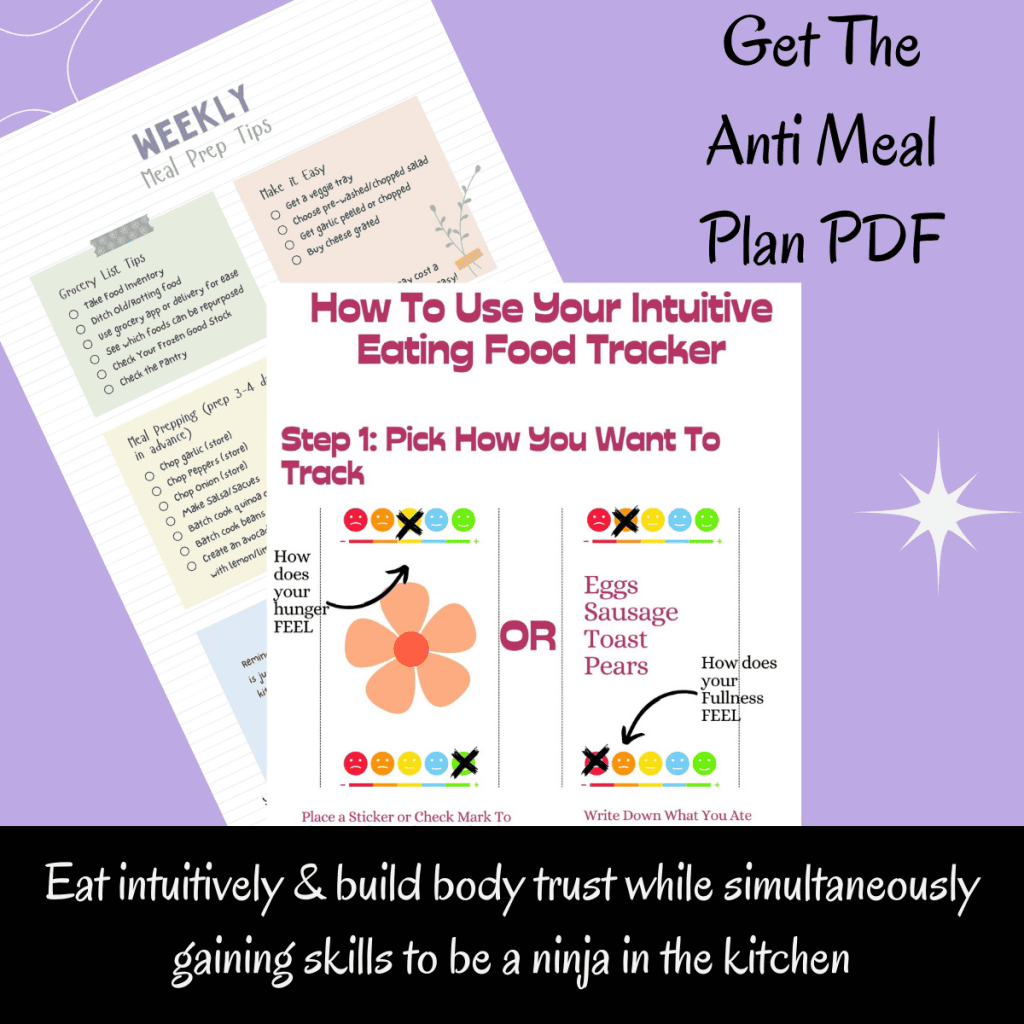
The more you start to learn about when you feel hunger and full and why, the more you’ll be able to navigate food with ease. You can use a hunger and fullness scale to help you determine when its best for you to start and stop eating.

- 100 Snack Ideas for Eating Disorder Recovery - April 18, 2026
- Diet Culture is Toxic - December 22, 2025
- I Don’t Eat Anything White - December 11, 2025