Table of Contents
Last updated on October 19th, 2026 at 07:16 pm
You can hate how your body looks today and still feed it lunch. You can feel uncomfortable in your skin and still buy pants that don’t dig into your stomach.
That’s a place to start with body respect. You don’t have to wake up loving your stretch marks or feel personally inspired by a “you’re beautiful” bumper sticker before your body deserves care.
Learning how to respect your body means practicing that care even when your feelings haven’t caught up. No appearance requirements. No waiting until you’re smaller.
What Does It Mean to Respect Your Body?
Body respect means treating your body as deserving of nourishment, comfort, boundaries, and care, whatever its size or appearance. It includes how you feed it, what you ask it to tolerate, and whether you let yourself participate in life.
Respecting your body is also one of the principles of intuitive eating. You can begin practicing it without having intuitive eating figured out or feeling ready to accept every change in your body.
Liking your appearance is a feeling. Respecting your body involves choices you can practice while that feeling is nowhere to be found.
| Situation | One way to practice body respect |
| Your jeans dig into your stomach. | Choose something that fits your body today. |
| You feel guilty about eating. | Continue with your next planned meal or snack. |
| Someone comments on your weight. | Set a boundary or leave the conversation. |
| You feel pressure to exercise through exhaustion. | Rest and discuss movement with your treatment team if you’re in recovery. |
| You dislike how you look in a photo. | Let the picture hold a memory without making a decision about changing your body. |
These are options, not another checklist to get a perfect score on. Start with the one that would make today a little less miserable.

1. Feed Your Body Before You Feel Good About It
Your body does not need to earn food by being attractive, productive, or a particular size. It needs nourishment on the days you feel confident and on the days you want to hide under a blanket.
Practice eating enough, eating regularly, and making room for foods you enjoy. If you’re working with an eating disorder team, following your individual meal plan is a form of body respect, even when the eating disorder has a very loud objection.
Eating disorders can disrupt hunger and fullness signals. So “listen to your body” shouldn’t become a reason to skip food when hunger is absent.
You also don’t have to eliminate guilt after eating before you nourish yourself. You can feel guilty and still take the next bite.
2. Wear Clothes That Fit Your Body Today
I don’t know what it is about clothing sizes, but they have the incredible superpower of making just about everyone feel like shit.
Outgrowing your favorite jeans can feel like losing a piece of your identity. Suddenly a pair of pants seems qualified to assess your discipline, your worth, and whether you deserve to leave the house. This is why it can feel so overwhelming to let go of your “sick clothes” in eating disorder recovery.
Clothes were designed to fit us. Your body doesn’t owe a waistband anything.
If replacing your wardrobe isn’t financially possible, start with one comfortable option you already own. Consider a clothing swap, secondhand options, or putting the most distressing clothes out of your daily line of sight.
You don’t have to feel fabulous in the replacement. Being able to sit down without a button attacking your stomach is a perfectly useful beginning.
3. Make Everyday Comfort Count
Shielding your eyes from bright sunlight is body care. So is putting something on an itchy bug bite or taking off shoes that hurt.
These moments count even if you never once think, “Wow, I love my body.” You noticed discomfort and responded.
Choose one ordinary need to meet more consistently: a bathroom break, sunscreen, dental care, a comfortable place to sit, or enough time to sleep. A new skincare routine can be lovely, but it doesn’t replace adequate food or needed medical care.
4. Let Rest Be Part of Body Respect
You don’t have to turn every free hour into an opportunity to improve your body. Rest doesn’t need a calorie calculation attached to it.
If movement is part of your life, consider whether there is room to change plans when you’re tired, sick, injured, or simply need a break. Movement doesn’t have to be part of today’s body-respect practice.
If you have an eating disorder, ask your treatment team what movement, if any, is appropriate for your stage of recovery. Recovery includes addressing excessive exercise; calling a workout “joyful” doesn’t automatically make it supportive.

5. Set Boundaries Around Body Talk
Your body is not an invitation for public commentary. You don’t owe someone a debate about your weight because they’ve decided their opinion is helpful.
One boundary that has helped me is: “Don’t talk about bodies unless they’re on fire. This goes for my body, your body, anyone’s body on TV, or anyone’s body around me.”
You can also keep it short:
- “I’m not discussing my weight.”
- “Please don’t comment on what I’m eating.”
- “Let’s change the subject.”
- “I’m going to step away if this continues.”
You can’t prevent every body-shaming message from reaching you. You can decide which conversations you participate in and what access people have to you when they keep crossing a boundary.
6. Change What You See in Your Feed
If your social media feed keeps telling you that your stomach is an emergency, it makes sense that opening the app feels awful.
Here’s something to remember: your social media feed feeds you what you feed it. In other words, if you’re constantly slowing down or clicking on weight centered posts you’re going to see more of them! Get that crap out of your space!
Mute or unfollow accounts that pull you toward restriction, comparison, or compulsive exercise. Hide unwanted ads, use the platform’s ad controls, or take a break from scrolling.
You might also follow people in a wider range of bodies whose content you actually enjoy. Your feed can include hobbies, humor, art, and people living their lives without making body size the main event.
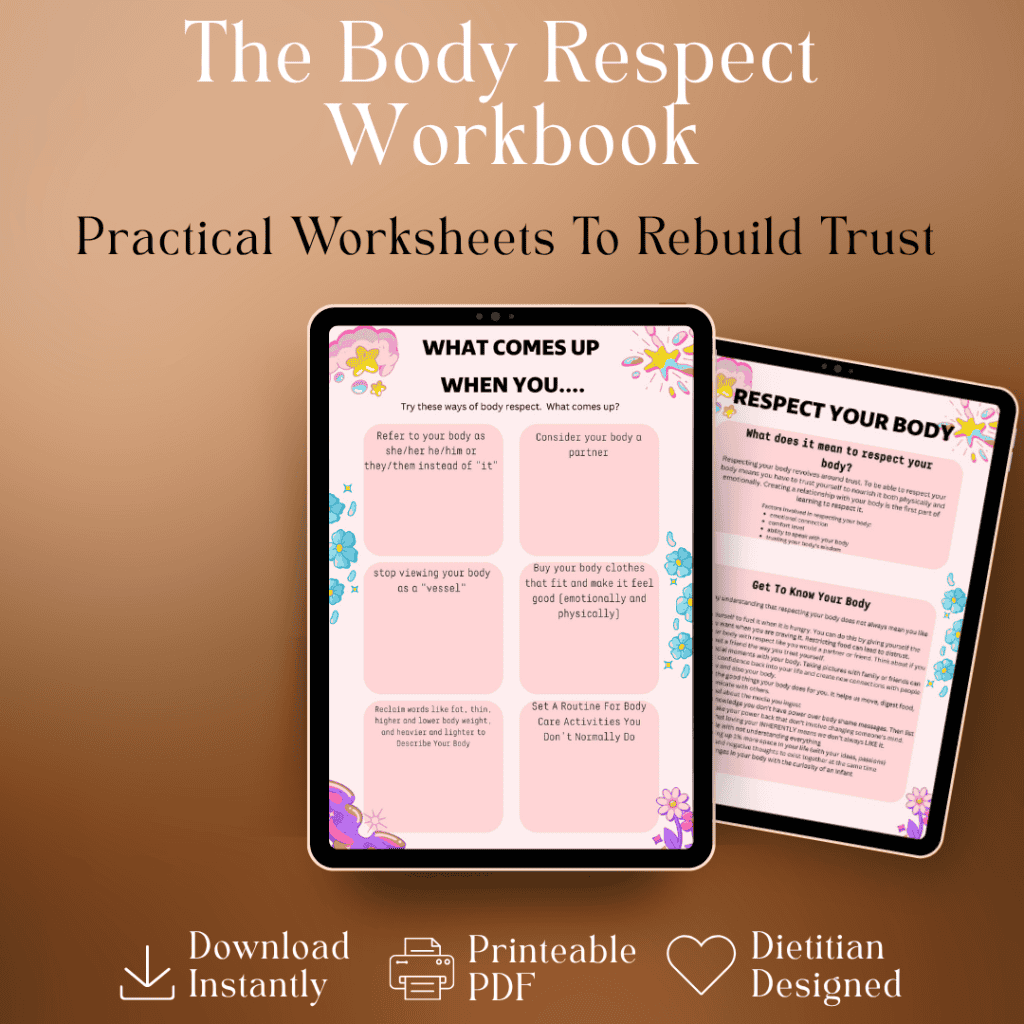
7. Consider your body a partner
Because your body actually IS your partner. In reality- it’s the most intimate partner you’ll ever have for the rest of your life.
Stop viewing your body as a “vessel.” Vessels are disposable. They are intended to carry “quality goods.” Your body is a piece of your identity. It moves along with you as part of every lived experience. It is not disposable or something that can be separated from its contents!
Think about how you’d treat a partner you care about: you’d take their needs seriously, make room for discomfort, and avoid making affection conditional on their appearance.
Some ways to practice that with your body:
- Respond when it needs something. Eat, use the bathroom, adjust your position, or take a break instead of repeatedly saying, “You can wait.”
- Check in before making demands. Before agreeing to another commitment, notice whether you need food, rest, or a less packed day.
- Make room for comfort. Wear clothes that fit, turn down overwhelming noise, or ask for a chair instead of forcing yourself to tolerate discomfort.
- Protect its boundaries. Decline unwanted touch and shut down conversations about your weight. Other people’s comfort doesn’t automatically outrank yours.
- Stay on its side when things are hard. Bloating, fatigue, pain, and body changes deserve care rather than punishment.
- Follow through consistently. Keep eating and resting on bad body image days. Care shouldn’t disappear because you’re upset with how your body looks.
- Get help when you need it. You don’t have to understand every symptom to seek medical care or ask your treatment team for support.
In eating disorder recovery, being a caring partner can mean following your meal plan even when hunger signals are unclear or the eating disorder objects.
You don’t have to feel deeply connected to your body to begin. Sometimes being its partner means, “I’m having a hard time with you today, and I’m still going to take care of you.”
8. Make Touch and Intimacy Your Choice
Body respect includes deciding who touches you, where, and when. You can want a hug, decline a massage, keep your clothes on, or change your mind during an intimate moment.
You do not have to tolerate unwanted touch to prove you accept your body. Saying “stop” or “I don’t want that” can be the most respectful action available.
If you decide you do want to practice receiving touch:
- Choose a person you trust. Someone who will stop when you ask, without sulking, arguing, or making you explain yourself.
- Start with touch you actually want. That might mean holding hands, a brief hug, or having someone rest a hand on your shoulder. You don’t have to start with the part of your body you feel most uncomfortable about.
- Make the boundaries specific. Try: “I’d like you to hold my hand, but I don’t want to be pulled closer,” or “A back rub sounds nice. Please keep your hands over my shirt.”
- Let yourself guide it. You can choose the pressure, position, and length of the touch. “Lighter,” “stay there,” and “that’s enough” are useful instructions.
- Keep appearance out of it. You can ask someone to skip comments about your body, including compliments, so you can focus on how the touch feels.
- Pause and check in. Notice whether you want more, something different, or a break. You don’t have to wait until you’re overwhelmed to stop.
- Finish without raising the stakes. Holding hands can just be holding hands. Enjoying one kind of touch doesn’t mean you’ve agreed to anything else.
The goal is to experience touch you choose and have your boundaries respected. A short hug that ends when you want it to counts.
9. Practice Neutral Language Without Forcing It
Words about body size often carry years of judgment. Some people find reclaiming words such as “fat” helpful; others aren’t ready or don’t want to describe themselves that way.
You get to choose your own language. You don’t need to force a label to prove you’ve rejected diet culture.
Start by noticing when a description turns into a verdict. “My body has changed” tells you something different from “I’ve failed.”
10. Let a Hard Thought Exist Beside a Caring Action
You don’t have to argue yourself into believing you’re beautiful every time a painful thought shows up. Sometimes that argument just eats up the afternoon.
Try an “and” statement that leads to something you can do: “I’m uncomfortable with my stomach today, and I’m still going to eat dinner.”
| When this shows up… | A response you can try | One action |
| “I hate how these clothes look on me.” | “I’m upset, and I deserve to be comfortable.” | Change into something that doesn’t pinch. |
| “I need to make up for what I ate.” | “The urge is here, and I can follow my recovery plan.” | Have your next planned meal or snack. |
| “Everyone will judge my body.” | “I can feel exposed and still choose company I enjoy.” | Message a supportive person or attend with them. |
| “I can’t stop looking for flaws.” | “I don’t have to solve my appearance right now.” | Step away from the mirror and begin another activity. |
Pick a response that feels believable. You’re allowed to stop well short of a glowing affirmation.
If checking your appearance is taking over your day, these ways to reduce body checking give you more specific places to start.
11. Explore Curiosity Only When It Feels Useful
After I had my daughter, I loathed my stretch marks. Over time, I came to enjoy their texture and the fact that no two patterns were alike. I also started to change the narrative around the stretch marks and how they were related to my identity and my relationship with my daughter.
I started to realize that my stretch marks:
- Always reminded me of my daughter and helped me feel close to her
- Were the only physical representation I had that I carried life (and my favorite person in the world). How amazing.
- For me – my stretch marks have become like a time machine back to memories of my daughters early stages of life. With her now being an adult, the stretch marks immediately take me back to some of my favorite early moments which honestly kinda feels like magic.
That’s my experience, not an assignment for you. You don’t have to find your stretch marks fascinating or beautiful for your body to deserve care.
If curiosity helps, notice a sensation without evaluating your appearance: warm water on your hands, a soft sleeve, or the support of a chair. If looking at or touching your body turns into more checking, choose an activity that directs your attention elsewhere.

12. Make Room for Change, Grief, and Limits
You can miss how your body used to look or function. You can be angry about pain, illness, aging, disability, or changes during recovery without losing your right to care.
Gratitude is optional. Your body deserves respect even when it cannot do something you wish it could.
You also don’t have to understand every sensation before asking for help. Seeking medical care, requesting an accommodation, or telling your treatment team something feels difficult can all be ways of responding to your body’s needs.

13. Commit to taking up 1% more space In your life
You might play small because you are ashamed of the size of your body. You might aim to make others comfortable and not disrupt the social stigma they have placed on certain bodies.
Are there things you keep postponing until your body looks different? Getting in a family picture, seeing a friend, wearing something you enjoy, or trying a hobby?
You can practice body respect by taking up the physical space your body occupies in the world unapologetically.
Reclaim your space by:
- Showing up in comfortable attire you enjoy
- Making yourself present in social situations
- Showing off your gifts and talents to the world
- Getting in front of an audience when you have an important message to deliver
- Taking risks you have been waiting to take until you were in a smaller size.
You don’t have to start all at once. Just start out taking up 1% more space. Introduce yourself to a new friend or post a raw, unedited photo of yourself on social media.

14. Loving Your Body Doesn’t Mean Always Liking It
Think about someone you love deeply. You don’t have to like everything they do or every change they go through for your love to remain.
When we love a child, we expect them to grow and change. We don’t ask them to stay exactly as they are to keep deserving our care.
Our bodies deserve that same room to change. You can struggle with how your body looks or feels and still feed it, protect it, and treat it with compassion.
If your body only deserves kindness when it looks and behaves a certain way, that kindness comes with an expiration date. Your body will change throughout your life, and it shouldn’t have to earn your care all over again each time.
Start With One Act of Body Respect
You don’t need to do everything on this page today. Choose the next useful action: eat your snack, change your pants, or end the conversation about someone’s weight.
Your feelings may still be a mess afterward. You still practiced caring for your body.
You can do it again before you love what you see in the mirror.


- Dating Someone With an Eating Disorder: Supporting Them Without Losing Yourself - October 19, 2026
- The Evolution of Thinspo: From Pro-Ana Websites to SkinnyTok - September 19, 2026
- Meal Support For Eating Disorders - August 12, 2026