Table of Contents
Last updated on September 15th, 2026 at 03:58 pm
Written By Anthony Herbert Dietetic Student, Reviewed by Shena Rose, RD
Male body image issues have always existed. We just haven’t always been very good at recognizing them.
When we talk about body image, eating disorders, or appearance pressure, the conversation still tends to focus heavily on women. Meanwhile, men are being bombarded with messages telling them to get leaner, bigger, more muscular, taller, sharper-jawed, less “soft,” more masculine, and somehow genetically superior to the guy standing next to them.
And now we have an entire internet vocabulary for it.
Looksmaxxing. Softmaxxing. Hardmaxxing. Mewing. Mogging. Cutting. Bulking. Biohacking.
Some of these practices may sound harmless on their own. Taking care of your skin or getting a haircut isn’t an eating disorder. Neither is wanting to feel attractive.The problem starts when self-care turns into I need to fix everything that’s wrong with me.
That’s where modern male body image culture can get ugly.
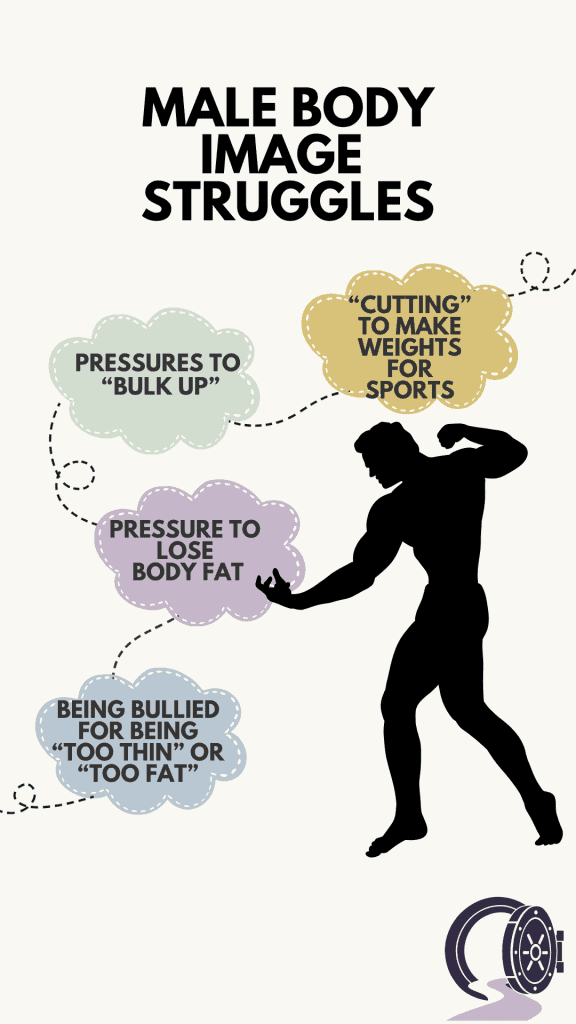
Male Body Image Pressures
Male body image struggles are real, common, and still significantly underrecognized.
Men are exposed to an incredibly narrow version of what an “attractive” male body is supposed to look like. Lean, muscular, tall, broad shoulders, narrow waist, visible abs, defined jaw, good hair, clear skin, and apparently not a single ounce of body fat that hasn’t received prior approval from the internet.That’s a pretty ridiculous standard for an actual human body.
For some men, the goal isn’t necessarily becoming smaller. It might be becoming bigger while simultaneously becoming leaner.More muscle. Less fat.Bigger shoulders. Smaller waist. More definition. More vascularity.
More everything, except body fat.
Male body image pressure can include:
- Pressure to bulk up or gain muscle
- Pressure to maintain extremely low body fat
- Constant “cutting” and bulking cycles
- Comparing muscle size and definition
- Feeling inadequate without visible abs
- Getting bullied or mocked for being too thin, too fat, too short, or not muscular enough
- Obsessing over jawline, facial structure, height, hair, skin, or other physical features
- Constantly comparing yourself to other men online
- Treating food and exercise as tools for manipulating appearance rather than taking care of yourself
And there’s another layer to this.
Men are often taught that they shouldn’t care too much about appearance in the first place.
So you get this bizarre double bind where men are expected to look a very specific way while also pretending they aren’t trying very hard to look that way.
That makes body image distress incredibly easy to hide.

Looksmaxxing and the New Male Body Image Culture
Looksmaxxing is essentially the pursuit of maximizing physical attractiveness. Some of the practices that fall under that umbrella are pretty ordinary. Others can become obsessive, expensive, painful, dangerous, or deeply tied to body dysmorphia.
The language varies, but you’ll commonly see:
Softmaxxing refers to less invasive appearance changes such as changing your hairstyle, skincare, clothing, grooming, exercise, or nutrition.
Hardmaxxing pushes appearance modification much further and may involve cosmetic procedures, surgery, extreme dieting, aggressive exercise, or other major attempts to change the body or face.
Mewing generally refers to deliberately changing tongue posture with the belief that it can improve the jawline or facial structure (resting the tongue against the roof of the mouth instead of letting it sit low in the mouth).
And this is a good example of how looksmaxxing can feed body obsession. Something you probably never thought twice about, like where your tongue sits when you’re doing absolutely nothing, can suddenly become another body part to monitor, analyze, compare, and try to “fix.”
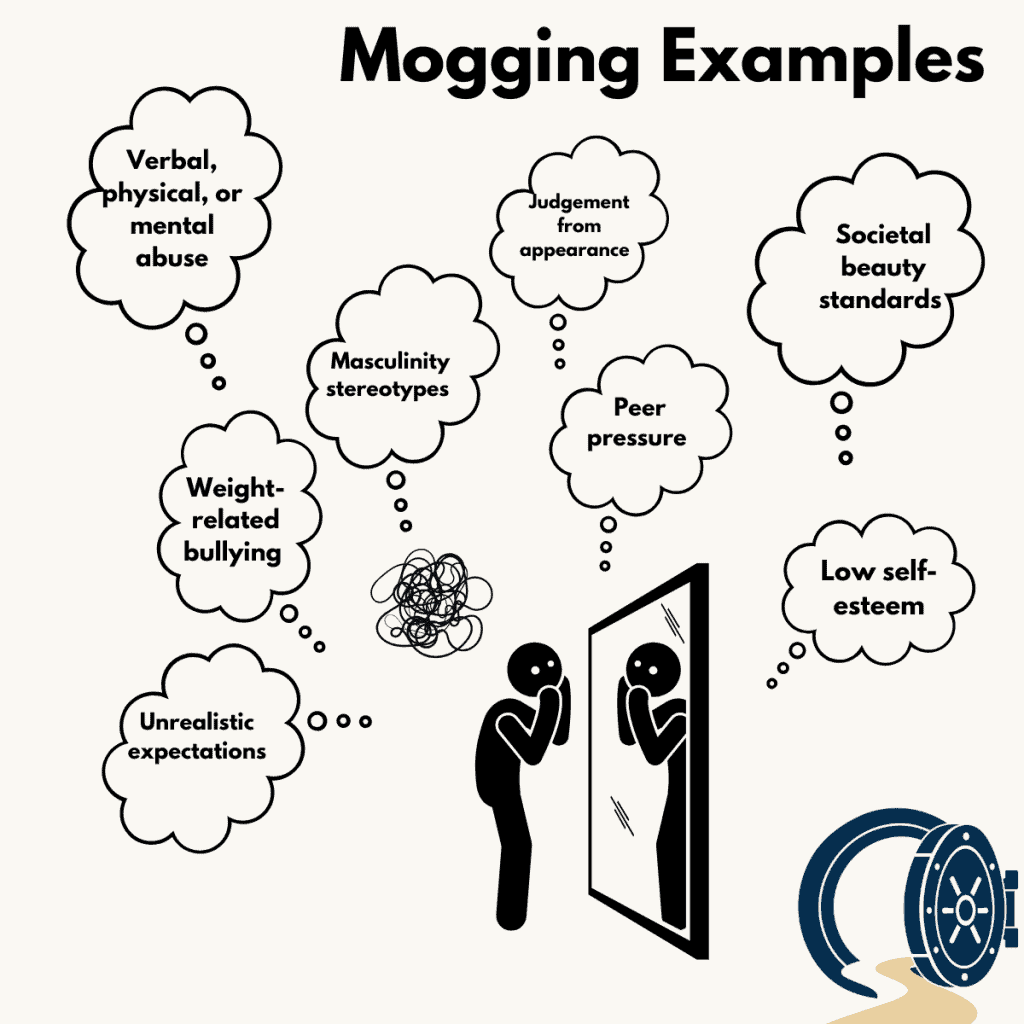
Mogging is comparison taken to another level. Someone “mogs” another person when they’re perceived as physically superior, often because they’re taller, leaner, more muscular, or considered more conventionally attractive.
And that’s where this stuff can get particularly toxic.
Your body stops being your body and starts becoming a scoreboard.
Instead of asking:
- Do I feel good?
- Am I eating enough?
- Do I enjoy moving my body?
- Do I like how I’m living?
- The questions become:
- Am I lean enough?
- Is my jaw sharp enough?
- Are my shoulders wide enough?
- Is someone else taller than me?
- Does this guy mog me?
There’s always another feature to fix and another person to beat.
That’s not body confidence. That’s an exhausting way to live.
When “Self-Improvement” Becomes Body Obsession
One reason male body image problems can be so difficult to recognize is that they’re frequently disguised as self-improvement.
Body obsession rarely introduces itself by saying:
“Hello. I’m here to make you miserable about your body.”
Instead, it can look like:
- “Peak performance”
- “Optimization”
- “Biohacking”
- “Clean bulking”
- “Cutting”
- “Getting shredded”
- “Discipline over feelings”
- “No excuses”
- “Becoming the best version of yourself”
- “Looksmaxxing”
Again, wanting to improve something about your appearance isn’t automatically a problem.
Context matters.
But if “improvement” requires constantly monitoring your body, restricting food, compulsively exercising, fearing body fat, spending hours comparing yourself to other men, or believing your appearance determines your worth, we aren’t just talking about grooming anymore.
We’re talking about body image distress.
Exercise Compulsion and Burnout in Men
Body image pressure can also drive compulsive exercise.
Movement stops being something you do because you enjoy it, want to get stronger, play a sport, clear your head, or take care of yourself.
Instead, exercise becomes something you have to do.
You might exercise to earn food, compensate for eating, control your body size, maintain an extremely low body-fat percentage, or avoid the guilt and anxiety that show up when you rest.
Over time, this can lead to:
- Physical burnout
- Overuse injuries
- Anxiety when workouts are missed
- Difficulty taking rest days without guilt
- Exercising despite injury or illness
- Decreased immune function
- Constant fatigue
- Losing your intuitive connection with your body
At that point, exercise isn’t supporting your health anymore.
It’s controlling your life.
Social Media Makes Male Body Comparison Almost Impossible to Escape
Social media didn’t invent male body image issues, but damn, did it give them somewhere to thrive.You’re no longer comparing yourself only to people you actually know.
You can compare your body to hundreds of genetically gifted, carefully posed, dehydrated, edited, filtered, professionally lit, or otherwise highly curated bodies before you’ve even finished your morning coffee. And algorithms learn quickly.
Watch a couple of videos about getting leaner or improving your jawline and suddenly your feed can become an endless parade of bodies and faces telling you what needs fixing.
The more extreme content becomes normalized, the more a perfectly ordinary human body can start looking “wrong.”
That’s a problem.
Eating Disorders: The Dark Side of Male Body Image Issues
Eating disorders in men are often missed because they don’t always resemble the stereotypical image people have of an eating disorder.
Someone may not say:
“I’m terrified of gaining weight.”
He might say:
“I’m cutting.”
He may not say:
“I’m restricting food.”
He might say:
“I’m eating clean.”
He may not recognize compulsive exercise as compulsive at all.
It’s just “discipline.”
This is one reason disordered behaviors can become normalized and even celebrated.Eventually, rigid food and body rules can turn into a toxic inner dialogue that makes you feel out of control with food and exercise.
And yes, that can become an eating disorder.
When achieving the “perfect body” starts taking over your life, it’s worth paying attention.
How Male Body Image Issues Affect Self-Worth
One of the biggest problems with appearance-based culture is that your body can slowly become your identity.
Being lean becomes proof you’re disciplined. Being muscular becomes proof you’re masculine.Having a certain face becomes proof you’re attractive.Being taller becomes proof you’re desirable.And suddenly your self-worth depends on maintaining characteristics that you either can’t completely control or can’t maintain forever.
Bodies change.We age. We get injured. We get sick. Our schedules change. Hormones change. Stress happens. Life happens.
If your entire identity is built around maintaining a specific body, normal body changes can feel like personal failure. They may challenge what you know about your identity and self worth altogether.
You might be dealing with significant body image distress or an eating disorder if you’re experiencing:
- Extremely low self-esteem
- Mentally restricting most foods
- Feeling like you hate your body
- Constant body checking
- Fear of weight gain
- Obsessively checking muscle definition or body-fat levels
- Constantly examining your face or jawline
- Comparing your height, musculature, hair, face, or body to other men
- Difficulty adapting to normal body changes
- Rigid identity around fitness or appearance
- Negative self-talk or an eating disorder voice
- Extreme food guilt
- Food shaming
- Fatphobia
- Fear foods
- Avoiding social situations involving food
- Food restriction
- Binging and fasting
- Body dysmorphia
You don’t need every item on this list before your struggle “counts.”
Clinical Impacts of Eating Disorders in Males
This is also where we need to stop pretending that a body that looks fit is automatically a healthy body.Behaviors that can develop from negative body image, including compulsive exercise, restrictive eating, under-hydration, purging, and laxative abuse, can become medically dangerous.
Clinical impacts of eating disorders in males can include:
- Muscle loss and atrophy
- Sexual dysfunction
- Hypoglycemia
- Low blood pressure
- Over- or under-hydration
- Increased injury risk
- Poor concentration and mood
- Electrolyte abnormalities
- Slow or rapid heart rate
- Cardiac complications
- Blood test abnormalities
- In severe cases, death
If you’re experiencing symptoms of an eating disorder, getting evaluated by qualified clinicians who actually understand eating disorders is important.
Getting Out of the Male Body Comparison Trap
You don’t have to delete every fitness account, stop caring about your appearance, or pretend you suddenly love every inch of your body. That’s not realistic.
A better starting point is paying attention to what your content is doing to you.
Try:
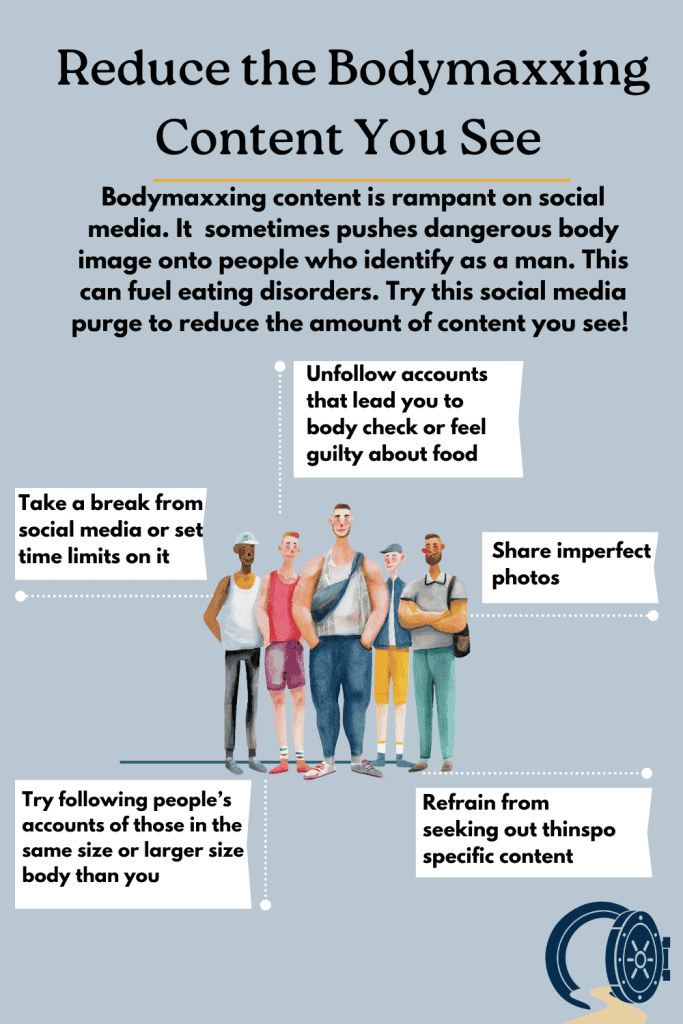
- Notice how you feel after consuming certain content, not just what the person claims to be teaching you.
- Unfollow accounts that consistently make you body check, restrict food, or feel like your body needs fixing.
- Pay attention to looksmaxxing, fitness, and “optimization” content that relies heavily on shame.
- Follow people in a wider variety of bodies.
- Seek out people who make you feel neutral or comfortable in your body rather than constantly inadequate.
- Share imperfect photos sometimes.
- Take breaks from social media or set limits around it.
- Stop intentionally seeking out content that sends you straight into comparison mode.
- Question whether “self-improvement” is actually improving your life.
That last one matters.
If your self-improvement routine makes you hate yourself more, something isn’t working.
Improving Male Body Image
Improving your body image doesn’t require believing you’re the hottest man alive. Body neutrality counts.
The goal can simply be reaching a place where your appearance doesn’t occupy so much damn mental space.
Supporting a healthier relationship with your body might include:
- Normalizing body diversity
- Talking openly about eating disorders and disordered eating in men
- Separating your worth from body size, muscularity, height, or leanness
- Challenging the idea that masculinity has a specific body type
- Learning to rest without feeling lazy
- Eating enough to actually support your body
- Respecting your body
- Getting rid of sick clothes without guilt
- Using body-positive affirmations
- Valuing energy, relationships, function, pleasure, and quality of life over aesthetics
- Getting curious about how much of your appearance standard actually came from you
Your body doesn’t need to win an internet ranking system.
It needs to carry you through your actual life.
Getting the Right Support
Male body image issues thrive when we keep pretending men don’t struggle with food, bodies, appearance, or eating disorders.
They do.
And struggling with these things isn’t somehow less serious because you’re a man or because your eating disorder looks more like “fitness” than the stereotypical version you’ve seen portrayed online.
The right support might include:
- Working with a HAES-aligned therapist
- Working with an eating disorder dietitian
- Using meal support if eating has become difficult
- Reading eating disorder recovery books and resources
- Finding spaces where men can actually talk about body image without having it dismissed or turned into another competition
You are allowed to care about how you look.
You’re also allowed to exist in a body without constantly trying to optimize it.
And health should be measured by how well you’re able to live your life, not whether some stranger on the internet thinks your jawline, body-fat percentage, or shoulder-to-waist ratio is good enough.
Male Body Image Issues FAQ
What are the most common body image issues in men?
Male body image issues often center around not feeling lean enough, muscular enough, tall enough, or conventionally attractive enough. Men may become preoccupied with body fat, muscle definition, height, hair, skin, facial structure, or having a more defined jawline. Social media, gym culture, and looksmaxxing communities can make these standards feel a hell of a lot more normal and achievable than they actually are.
What is looksmaxxing?
Looksmaxxing is the idea of “maximizing” your physical attractiveness through changes to your body, face, grooming, clothing, exercise, or lifestyle. Some forms are pretty harmless, but looksmaxxing can become a problem when improving your appearance turns into constantly monitoring, comparing, restricting, exercising, or believing you need to fix your body to be worthy or attractive.
What is the difference between softmaxxing and hardmaxxing?
Softmaxxing generally refers to less invasive appearance changes such as skincare, grooming, hairstyles, clothing, or exercise. Hardmaxxing refers to more aggressive or invasive attempts to change appearance, which can include cosmetic procedures or surgery. The terminology can vary between online communities, and neither category automatically tells you whether someone’s relationship with their appearance is healthy.
What is mewing?
Mewing involves deliberately positioning most of the tongue against the roof of the mouth, including the middle and back of the tongue. It’s often promoted online as a way to create a stronger jawline or change facial structure. Normal tongue posture plays a role in oral function, but the dramatic facial transformations promised by looksmaxxing content are another story.
More importantly from a body image perspective, mewing can turn something as basic as where your tongue rests into yet another feature you feel obligated to monitor and fix.
What does mogging mean?
Mogging is internet slang for being perceived as physically superior to another person, often because of height, muscularity, facial features, body composition, or overall attractiveness. The problem with this mindset is pretty obvious: bodies become a ranking system. There’s always someone to compare yourself to and another reason your own body supposedly isn’t good enough.
Can men have eating disorders without wanting to be thin?
Absolutely. Eating disorders in men don’t always revolve around wanting to become smaller. Someone may instead become obsessed with becoming leaner and more muscular, reducing body fat, getting “shredded,” or changing body composition.
Restriction, compulsive exercise, rigid food rules, cutting, fasting, and fear of gaining body fat can still be eating-disorder behaviors even when the stated goal is gaining muscle.
When does caring about your appearance become a body image problem?
Caring about your appearance isn’t inherently unhealthy. The bigger question is how much of your life does it take up?
If you’re constantly body checking, comparing yourself to other men, avoiding food, afraid to miss workouts, spending hours thinking about perceived flaws, or allowing your appearance to determine your self-worth, it’s worth taking seriously.
Your entire life shouldn’t have to revolve around making your body look better.

- Dating Someone With an Eating Disorder: Supporting Them Without Losing Yourself - October 19, 2026
- The Evolution of Thinspo: From Pro-Ana Websites to SkinnyTok - September 19, 2026
- Meal Support For Eating Disorders - August 12, 2026