Table of Contents
Last updated on November 17th, 2026 at 09:22 pm
Starvation syndrome is what happens to your body, brain, and social life when you go too long without enough food. It shows up in all kinds of food restrictions, and an eating disorder is one of the most common ways people end up there.
A syndrome is a group of symptoms that tend to show up together. With starvation syndrome, that group includes:
- Physical changes in the body from not eating enough
- Mental health struggles caused by food restriction
- Pulling away from people because of food avoidance
Your eating disorder will happily tell you these are personality flaws. Most of them are your body running on fumes. Let’s dig into how starvation affects your body and brain, and how to reverse it.
What Causes Starvation Syndrome
Starvation syndrome is caused by not eating enough food to meet your body’s needs. That can happen because of:
- Not having enough food available to eat
- A medical issue that makes eating difficult
- Intentional food restriction, like in an eating disorder
In an eating disorder, starvation can come from restricting, excessive exercise, purging, laxative use, or some combination. This article focuses on intentional food restriction.
The restriction usually comes first, and the mental and social fallout follows. Starvation syndrome is not an official diagnosis you’ll find in a medical manual. It’s a description of what starving does to a whole person, and it’s a big part of why recovery starts with food.
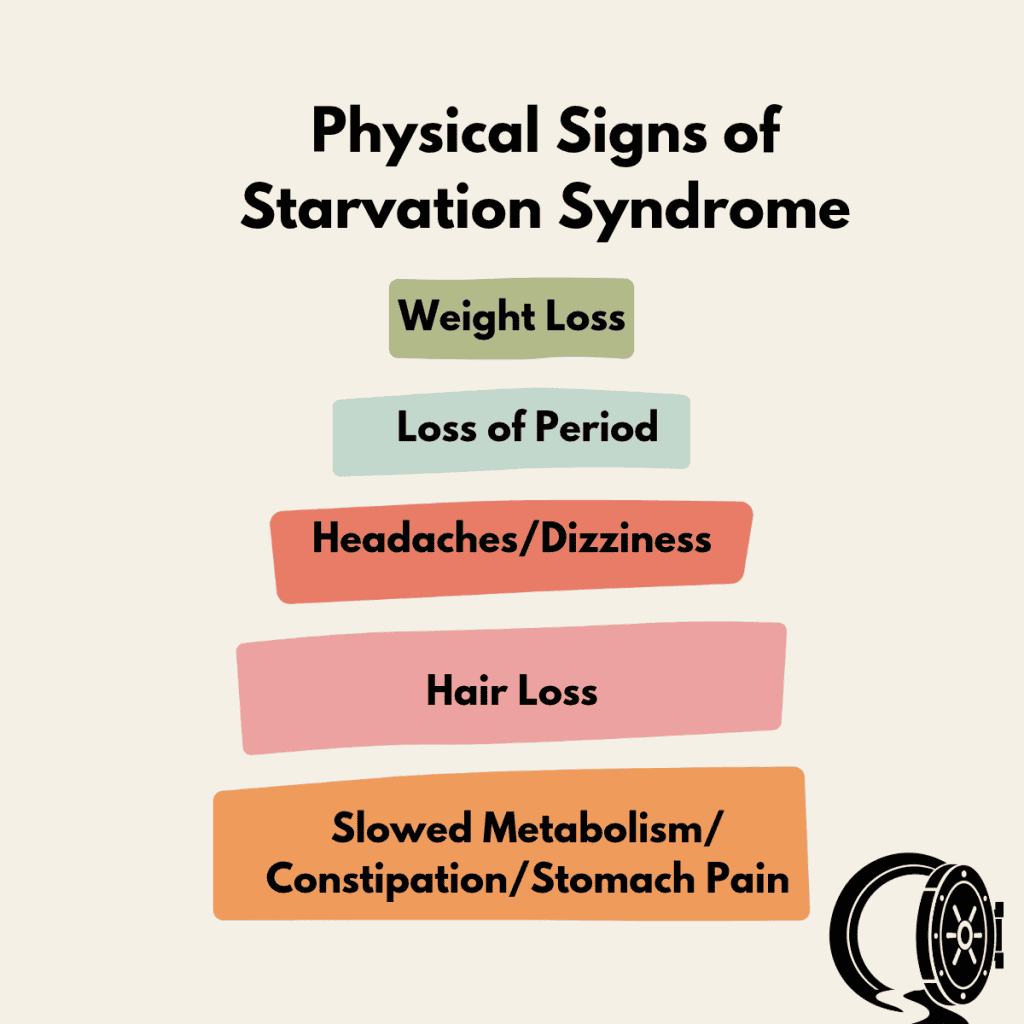
What Are The Effects of Starvation Syndrome
The first signs of starvation are physical. But starvation doesn’t stay in its lane, and it quickly takes a bite out of every part of your life.
The best evidence we have for this comes from the Minnesota starvation experiment. In 1944, 36 healthy young men with no eating disorders volunteered to be partially starved for six months, eating about half of what they had been eating before. What happened to them looks a whole lot like an eating disorder.
Physical Symptoms of Starvation
When food runs short, your body starts cutting its own budget to survive. It slows down anything it can live without and saves energy for your heart and brain. Here’s what that looks like, system by system.
| Body system | What starvation does | What you might notice |
| Heart and circulation | Heart rate and blood pressure drop, and the heart muscle can shrink | Slow pulse, dizziness when you stand up, feeling faint |
| Digestion | Food moves through your stomach and gut more slowly | Fullness after a few bites, bloating, constipation, IBS-like symptoms |
| Thyroid and hormones | The body lowers thyroid hormones on purpose to save energy | Tiredness, feeling cold, night sweats |
| Periods and sex drive | Reproductive hormones shut down because making a baby is not a priority during a famine | Missing or irregular periods, low sex drive |
| Temperature | Less body fat and a slower metabolism make it hard to stay warm | Always cold, especially your hands and feet |
| Brain | Brain volume shrinks | Trouble concentrating, headaches, foggy thinking |
| Blood sugar and labs | Less fuel coming in means less sugar in your blood, and blood cell counts can drop | Low blood sugars, shakiness, abnormal lab values |
| Bones | Bone breaks down faster than it builds | Usually nothing until a stress fracture or a bone density scan |
| Hair and skin | Hair growth slows and the body grows fine hair to hold in heat | Hair loss, dry skin, lanugo (soft, fine body hair) |
| Energy and muscle | The body breaks down muscle for fuel | Low energy, weakness, getting tired faster |
Sources: Mehler and Brown, 2015; InsideOut Institute.
The brain changes sound the scariest, so here’s the good news. A review of 29 brain imaging studies found that adults who stayed recovered had brain volumes back in the normal range. There’s less research on teens, so we can’t promise the same for them yet.
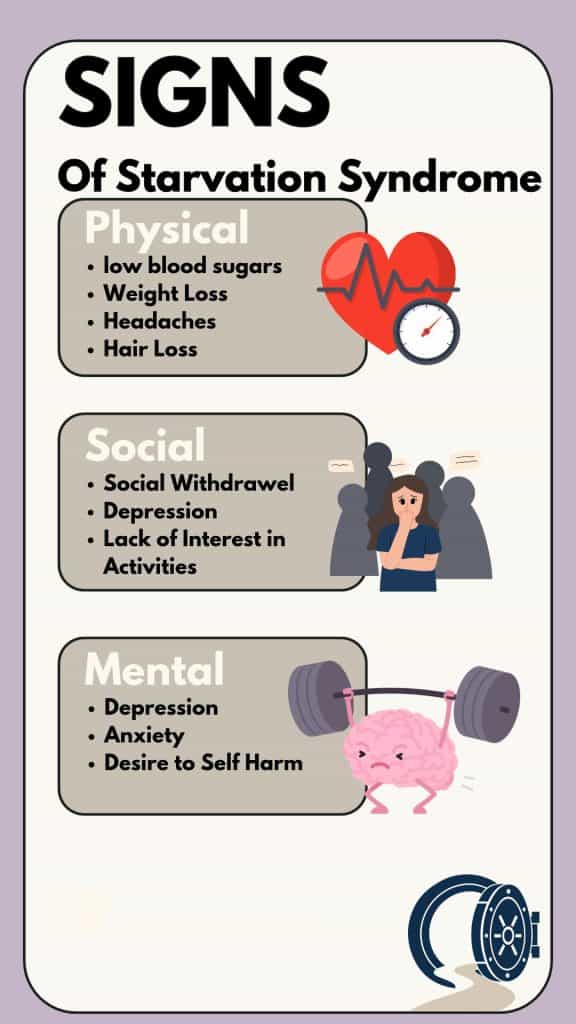
Mental Symptoms of Starvation
Mental health conditions like depression and anxiety can lead to food restriction. Starvation can also cause those same symptoms, which makes it really hard to tell which came first.
The Minnesota men are the clearest proof. They had no eating disorder going in, and within months they were acting a lot like people who do.
| What happened to the men in the Minnesota study | How it shows up in an eating disorder |
| Food became the main thing they thought, talked, read, and daydreamed about | Constant food thoughts, head hunger, and planning tomorrow’s meals while eating today’s |
| They collected cookbooks, recipes, and kitchen tools | Hours on recipe videos and food content, or baking for everyone except yourself |
| Meals got slow and silent, sometimes taking up to two hours | Cutting food into tiny pieces, eating in a set order, and other eating rituals |
| They loaded up on salt and spices and drank huge amounts of coffee and gum | Hot sauce on everything, diet soda, coffee, and gum to fill the gap |
| Some hoarded food, and some binged and then purged | Hiding food, binge eating after restriction, and purging |
| Easy-going men became irritable, anxious, and depressed | Low mood, a short fuse, and anxiety that gets worse around meals |
| Some exercised more to earn extra bread | Compensating with exercise or “earning” food |
| They saw themselves as normal and thought other people looked too fat | Not seeing how sick you are, and judging other bodies harshly |
Sources: InsideOut Institute; Kalm and Semba, 2005.
Starvation can also bring thoughts of self-harm or suicide. If you’re having those thoughts, you deserve help right now. In the US, you can call or text 988 any time to reach the Suicide and Crisis Lifeline.
Social Symptoms of Starvation
The Minnesota men got more withdrawn as the study went on, spending more time alone and losing interest in people they cared about. An eating disorder does the same thing, with a side of secrecy. Social symptoms can look like:
- Avoiding parties and gatherings
- Refusing to eat with family and friends
- Refusing to eat out
- Conflict around how food is made and what gets eaten
- Isolating from friends and family to hide restriction
Your eating disorder likes you alone, because nobody is around to notice what you’re not eating.
What Organs Shut Down First When You’re Starving
Your body is very good at adapting to starvation, at least for a while. It slows everything it can to stretch whatever food you give it. Those early changes are your body protecting you, and they can look harmless on the outside.
But adaptation has a limit. Over time, major organs like the heart, liver, and kidneys start to fail, and medical complications cause more than half of all deaths in anorexia.
| Organ | Early changes (your body adapting) | Later danger signs |
| Digestion | Stomach empties slowly, called gastroparesis, plus constipation | Severe belly swelling or pain, vomiting, or not passing stool for days |
| Heart | Slower heart rate and lower blood pressure | Fainting, chest pain, a racing or irregular heartbeat |
| Thyroid | Lower thyroid hormone to save energy, which goes back to normal with food | Usually no lasting damage, since it recovers with food. Thyroid medication is not the fix here |
| Brain | Shrinking brain volume and changes in brain chemicals | Confusion, seizures, or passing out |
| Liver | Liver lab values creep up | Much higher liver values, which can also happen during refeeding |
| Kidneys | Dehydration means less blood flows through the kidneys, and purging drains potassium, which kidneys need to work well | Kidney damage that can become permanent, especially after years of purging. It often has no symptoms, and the usual kidney blood test can look falsely normal |
| Blood sugar | Lower blood sugar between meals | Very low blood sugar, which can be life-threatening |
| Bones | Bone density starts dropping | Osteoporosis and fractures |
Sources: Mehler and Brown, 2015; Puckett, 2023.
Anything in that last column needs emergency medical care, not a wait-and-see approach. Normal labs don’t mean you’re safe either, because blood tests often look fine right up until they don’t.
How Do I Know If My Body Is In Starvation Mode
Starvation doesn’t look the same in everyone. One person gets ravenous while another feels nothing at all, and both are signs your body isn’t getting enough.
Some common signs your body is in starvation mode:
- You’re always cold
- You’re dealing with extreme hunger
- You have no hunger cues at all
- You have stomach pain, bloating, or swelling in your feet and ankles
- You wake up with night sweats
- You can’t concentrate
- You’re tired all the time
- Food is the loudest thought in your head
If several of these sound familiar, your body is telling you it needs more food. You don’t have to wait for a scale or a doctor to confirm it.
Starvation and Body Weight
You can be at any weight and have starvation syndrome. The idea that you must be in a low body weight to be starving is a myth, and diet culture keeps it alive because it’s great for business.
Someone in a “normal” BMI range who is starving may be diagnosed with atypical anorexia. The Minnesota men had lost about a quarter of their body weight, and people in larger bodies who lose that much usually get compliments instead of concern.
Starvation in larger or average-sized bodies comes with:
- The same physical, mental, and social declines in health
- Sometimes greater health risks, because malnutrition isn’t caught right away
- Less access to treatment because of weight stigma
Your body doesn’t check your jeans size before it starts shutting things down.

Treating Starvation Syndrome
The treatment for starvation is food. Consistent, adequate, enough-even-when-your-eating-disorder-screams food.
When hunger cues are missing or unreliable, mechanical eating helps. That means eating on a schedule whether you feel hungry or not. An eating disorder dietitian can tailor a plan to you if you have access to one, but you can start without one.
Steps for treating starvation syndrome include:
- Following a recovery meal plan with three meals and two to three snacks a day
- Weight restoration, including any overshoot weight your body needs
- Getting support during mealtime from someone you trust
- Building strategies to stop purging if you’re purging
- Getting mental health support to handle the stress and anxiety that come with eating more
- Challenging fear foods
One step needs a doctor. If you’ve been eating very little for a while, increasing food quickly can cause refeeding syndrome, a dangerous shift in fluids and minerals like phosphorus that can affect your heart. A doctor can check your blood in the first weeks so you can eat more safely.
What To Expect When You Start Eating Again
Recovery from starvation has its own set of weird and uncomfortable symptoms. Most of them mean your body is repairing, even when they feel like proof you’re doing it wrong.
| What happens in recovery | Why it happens |
| Extreme hunger | Your body is making up for months or years of not getting enough |
| Fullness, bloating, and gastroparesis | Your stomach slowed down during starvation and takes time to speed back up |
| Swelling in your face, belly, feet, or ankles | Your body is shifting fluid as it starts using food again |
| Night sweats and feeling hot after meals | Your metabolism is waking up and burning more energy |
| Hypermetabolism | Repair work burns so much energy that you need more food than expected to gain weight |
| Overshoot weight | Your body rebuilds a little extra before it settles. The Minnesota men regained their weight plus about 10%, then lost some of it over the next six months |
| Refeeding syndrome | A dangerous mineral and fluid shift that is most likely in the first weeks, which is why blood tests matter early |
Sources: InsideOut Institute; Mehanna et al., 2008.
Even the Minnesota men, who had no eating disorder pulling the strings, took anywhere from two months to two years to recover. If recovery feels slow, blame the starvation and keep eating.
Staying strong through eating disorder recovery can feel impossible some days. These eating disorder recovery books and my eating disorder story show the journeys of people who’ve been where you are.

- Dating Someone With an Eating Disorder: Supporting Them Without Losing Yourself - October 19, 2026
- The Evolution of Thinspo: From Pro-Ana Websites to SkinnyTok - September 19, 2026
- Meal Support For Eating Disorders - August 12, 2026