Table of Contents
Last updated on October 13th, 2026 at 08:26 pm
What Is Food Neutrality
Do you ever finish a meal and immediately file it under “good” or “bad”?
Maybe you feel accomplished because you ate “clean” at lunch. Or guilty because you had a doughnut for breakfast. Maybe eating one food makes you feel like you’ve been “good,” while another leaves you mentally calculating how you’re going to make up for it later.
That constant mental scorekeeping is exhausting.
Food neutrality is the idea that food doesn’t have moral value. Eating a salad doesn’t make you good, and eating cake doesn’t make you bad.
Foods have different nutrients, purposes, tastes, textures, and effects on your body. But they don’t belong in a moral hierarchy.This idea tends to get some serious pushback in a world steeped in diet culture, where we’ve been taught to categorize food according to what we think it might do to our weight, shape, or size.
Practicing food neutrality means:
- Identifying and dismissing food rules
- Developing a relationship of trust with your body
- Letting go of arbitrary rules about “moderation”
- Identifying and exposing yourself to fear foods to decrease anxiety around specific foods
- Purchasing, preparing, and enjoying all types of foods without assigning morality to them

Healthy Food vs. Unhealthy Food
As a dietitian, I hate the word healthy.
There. I said it.
When someone tells me a food is “healthy,” my first question is: What exactly do you mean by healthy?
High protein? High fiber? Lots of vitamins? Low carb? Something you actually enjoy enough to eat? Because “healthy” can mean a thousand different things depending on who you’re talking to. I’ve never heard two people (including health professionals) give exactly the same definition of a “healthy food.”
Here are just a few things that could theoretically make a food “healthy”:
- It provides protein
- It contains carbohydrates
- It provides calories—or, as your body calls them, energy
- It contains fat
- It provides vitamins
- It contains minerals such as zinc or iron
- It provides calcium
- It is accessible
- It is satisfying
- It is something you can actually eat
And suddenly our neat little “healthy vs. unhealthy” system starts falling apart.
Because foods aren’t healthy or unhealthy in isolation. And most importantly- it’s not nutrition until it’s consumed. So if you’re eating food you think tastes like crap- you’re much less likely to eat it in abundance (or at all) so that you actually get the dang nutrients the food has to offer!
Nutrition depends on the person eating the food, what their body needs, what else they’re eating, their medical needs, their access to food, and about a hundred other things.No single food contains everything your body needs.And no single food needs to.That’s why we eat more than one food! The problem with labeling food “healthy” and “unhealthy” isn’t just that the definitions are inconsistent. It’s that those labels very quickly become judgments about you.
For example:
I ate healthy today = I was good.
I ate junk food today = I was bad.
And now we’re not talking about nutrition anymore.We’re talking about morality.

All Food Has Nutritional Value
There is no such thing as nutritionally worthless food.
There, I said that too.
One of my favorite things to do with patients is have them name a food they think has “nothing good in it,” and then we find the nutrition. Try it. Pick a food you’ve mentally labeled as junk, bad, empty, or unhealthy. Look at what it actually provides.
Food can provide:
- Energy your body needs to stay alive
- Carbohydrates, protein, and/or fat
- Vitamins and minerals
- Satisfaction and pleasure
- Convenience and accessibility
- Cultural or emotional connection
Sometimes the thing your body desperately needs from food is iron. Sometimes it’s protein.Sometimes it’s carbohydrates (and yes- this even includes simple carbohydrates like table sugar or high fructose corn syrup). These types of simple carbohydrates can be the difference between winning a race or even saving your life if you’ve accidentally gone too long without a meal.
Nutrition doesn’t stop being nutrition because it came wrapped in plastic. And sometimes you haven’t eaten in six hours and what you need is a freaking Pop-Tart.
Oh and as for “eating clean” and “only shopping the perimeter”…. Well this dietitian is convinced that’s all just marketing propaganda invented by diet culture to steal your money and chip away at your soul. Is it working?
Are Superfoods Better Foods
Ah, superfoods.
The idea behind labeling something a “superfood” is usually that it’s particularly nutrient-dense—meaning it provides a lot of certain nutrients relative to the amount of food or energy it contains. Eating a lot of superfoods can also be called volume eating.
And that’s fine. I have nothing against kale. But your body doesn’t hand out bonus points because you ate something with the word “super” attached to it.
A few things to remember:
- More isn’t automatically better. Once your body has enough of something, piling on more doesn’t necessarily provide additional benefit. When it comes to nutrition- enough is as good as a feast.
- Nutrients interact with one another. Absorption and utilization are more complicated than simply adding up the numbers on a nutrition label.
- Your nutritional needs aren’t determined by one meal or one food. Nutrition happens over time.
- Nutrient density isn’t the only form of value. Energy, satisfaction, accessibility, convenience, culture, and enjoyment matter too.
I’m not bashing so-called superfoods. I love a good kale salad or coconut milk soup. But kale doesn’t earn a halo because it contains vitamin K, and chocolate cake doesn’t need to sit in the nutritional corner thinking about what it’s done.They are different foods.They provide different things.
Neither one determines whether you are healthy—or whether you are a good person.
How Food Hierarchy Harms
To make peace with food, you eventually have to dismantle the food hierarchy you’ve been carrying around in your head. You probably know exactly what yours looks like.
Maybe it’s:
- Apples and kale = good
- Pizza = questionable
- Fast food = bad
- Dessert = really bad unless you’ve “earned” it
The problem is that eventually those food labels become tangled up with your identity. You stop thinking: “I ate fast food.”
And start thinking:
“I’m bad because I ate fast food.” or “I ate vegetables today, so I was good.”
Food neutrality asks you to separate the food from the judgment. You ate the cheeseburger.That’s it. There doesn’t need to be a character assessment afterward.
Practicing Food Neutrality
Food neutrality sounds simple until you actually start paying attention to how many rules you’ve accumulated.
Start catching yourself whenever you think:
- This food is good or bad
- This food will make me gain weight
- I can have this, but only a certain amount
- I can eat this, but only at certain times of day
- I shouldn’t eat this more than once per week
- I already ate something “bad” today
- I need to eat something healthier later to make up for this
- I can have dessert because I exercised
- I shouldn’t want this food
Those are food rules. And sometimes they’re so automatic you don’t even recognize them as rules anymore.
A good question to ask yourself is:
If I removed weight, calories, and morality from this decision, what would I actually want to eat?
You may not know the answer yet.That’s okay. If you’ve spent years choosing food based on what has fewer calories, what feels “healthiest,” what won’t cause weight gain, or what makes you feel like you ate “well,” you may have gotten really good at answering:

Food Neutral Thoughts
Food neutrality is a practice, not a personality trait.
Imagine you couldn’t see the calories. Imagine neither choice could change your weight. Imagine there was no “better” choice and nobody—not your dietitian, your doctor, Instagram, your mom, or the random fitness guy at the gym—was going to give you a gold star for picking the salad.
Then ask:
- What sounds good right now?
- Do I want something hot or cold?
- Sweet or savory?
- Crunchy, creamy, chewy, soft?
- Something light and refreshing or warm and filling?
- What would actually satisfy me?
- What food keeps popping into my head that I keep talking myself out of?
- If I knew I could have this food again tomorrow, would I still want it right now?
- Am I choosing this because I want it—or because it feels safer?
Raising Kids With Food Neutrality
Kids aren’t born believing broccoli is virtuous and cookies require parental supervision.
We teach them that.
If you want to raise food-neutral kids, talk about and explore all foods with the same basic neutrality.
That means:
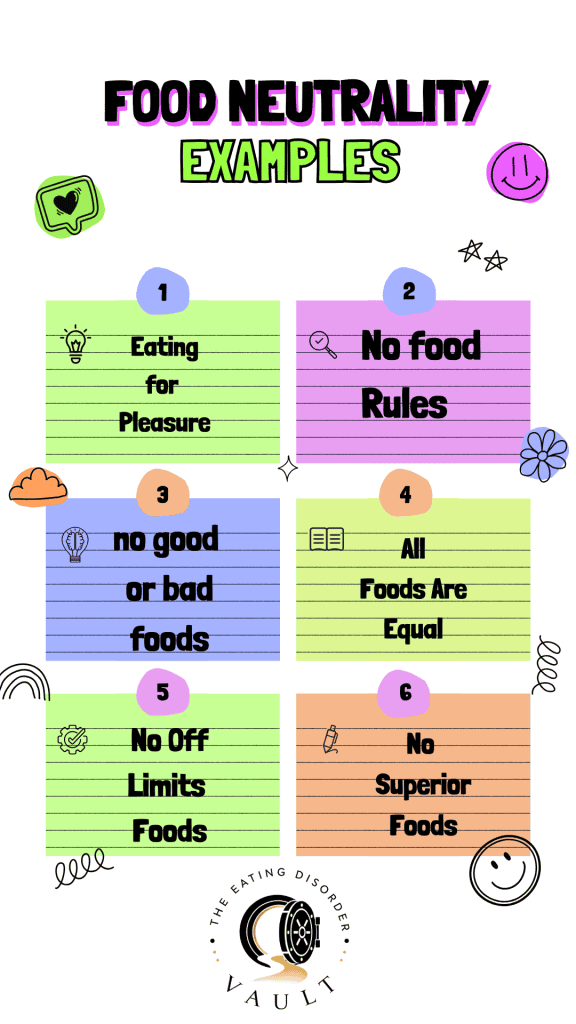
- Don’t label foods “good,” “bad,” “healthy,” “unhealthy,” “treat” or “junk”
- Avoid attaching virtue to food with statements like “this will make you strong”
- Practice the division of responsibility
- Don’t use highly desired foods as rewards
- Don’t make dessert dependent on finishing another food
- If your child moves between households, communicate about food expectations when possible so they aren’t navigating completely different food rules in each home
Kids need opportunities to experience a variety of foods without adults constantly telling them which foods they should want more of and which ones they should want less of.
Our job isn’t to micromanage every bite.
It’s to provide structure, access, exposure, and enough safety for them to learn about their own bodies.
What If I Start To Feel Out Of Control With Food?
This is where people panic. They stop restricting food and suddenly want it all the time.
Then they think:
SEE?! I knew I couldn’t be trusted around this food.
This is a lie diet culture tells you to keep you obeying your order and investing all of your time, resources and energy into it. But this is actually because Food restriction actually makes food more powerful, not the other way around. Restricting a food gives that food more control over YOU, not the other way around.
When you first start practicing food neutrality, it’s common to:
- Eat more than you’re used to eating
- Think about previously restricted foods constantly
- Want certain foods much more frequently
- Feel guilt or shame after eating something you were taught was “bad”
- Feel like you can’t stop eating your formerly forbidden foods
That doesn’t necessarily mean you have no self-control.
Instead, Think of it this way.
If pizza is an off-limits food and you finally get permission to have it tonight, your brain knows this opportunity might disappear tomorrow.So yeah, you might want a lot of pizza.
But what if pizza were available tomorrow?And Wednesday?And next week?And there wasn’t a deadline on eating it?
Eventually pizza becomes…pizza. Not your last chance.Not a cheat meal.Not a test of your self-control.
Just food.
That’s the point of food neutrality.

7 Tips For Going Food Neutral
- Challenge fatphobia
- Stop counting calories
- Cover nutrition labels if you find yourself compulsively checking numbers
- Challenge your fear of weight gain
- Practice body respect
- Slow down enough to notice and enjoy your food
- Reconnect with hunger and satisfaction cues when appropriate, using tools like a hunger scale
And remember: you don’t have to believe a food is neutral before you practice treating it neutrally.
The thoughts usually take longer to catch up.
Food Neutrality Affirmations
- Food doesn’t determine my worth
- I don’t have to earn what I eat
- I don’t have to compensate for what I ate
- My body is allowed to have preferences
- Satisfaction is part of eating
- Nourish your body without starving your soul
- I trust my body to learn what it needs
- One food cannot make or break my health
- Food is food—not a personality test
- The only thing I’m on a diet from is diets
FAQ: Food Neutrality
Is food neutrality the same as intuitive eating?
They’re related, but they’re not identical. Food neutrality describes how you view food—without ranking foods according to morality or creating a hierarchy of “good” and “bad.” Intuitive eating is a broader framework for rebuilding trust with your body and moving away from external food rules.
Food neutrality can be an important part of that process because it’s pretty damn hard to listen to your body while simultaneously telling yourself half the foods it wants are unacceptable.
Isn’t some food actually healthier than other food?
Different foods absolutely have different nutrient profiles.That’s not the same thing as saying one food is universally “healthy” and another is universally “unhealthy.” A food that’s appropriate for one person, situation, or nutritional need might be completely inappropriate for another.
Food neutrality doesn’t require pretending they’re nutritionally identical. It’s understanding that every nutritional profile can be valuable depending on the situation. And that every food offers SOME type of nutrition. That is in fact, what makes it food!
Won’t I overeat if I stop labeling foods good or bad?
You might eat more of previously restricted foods for a while.That doesn’t mean something has gone wrong.
When access to a food has been limited—physically or mentally—your interest in that food can become intense. Consistent unconditional permission gives your brain a chance to learn that the food isn’t disappearing again tomorrow.
The goal isn’t to achieve perfect “moderation.”It’s to get to the point where you don’t need a pile of rules to feel safe around food.
How do I explain food neutrality to my kids?
You don’t need to give them a nutrition lecture.Actually, please don’t.
Talk about foods without assigning morality to them. Skip “good,” “bad,” “healthy,” “unhealthy,” “treat” and “junk.” Offer a variety of foods and let your child have experiences with them. Try offering dessert with dinner instead of making dinner the obligation to get dessert.
The division of responsibility framework can help provide structure without turning eating into a power struggle.

- Dating Someone With an Eating Disorder: Supporting Them Without Losing Yourself - October 19, 2026
- The Evolution of Thinspo: From Pro-Ana Websites to SkinnyTok - September 19, 2026
- Meal Support For Eating Disorders - August 12, 2026